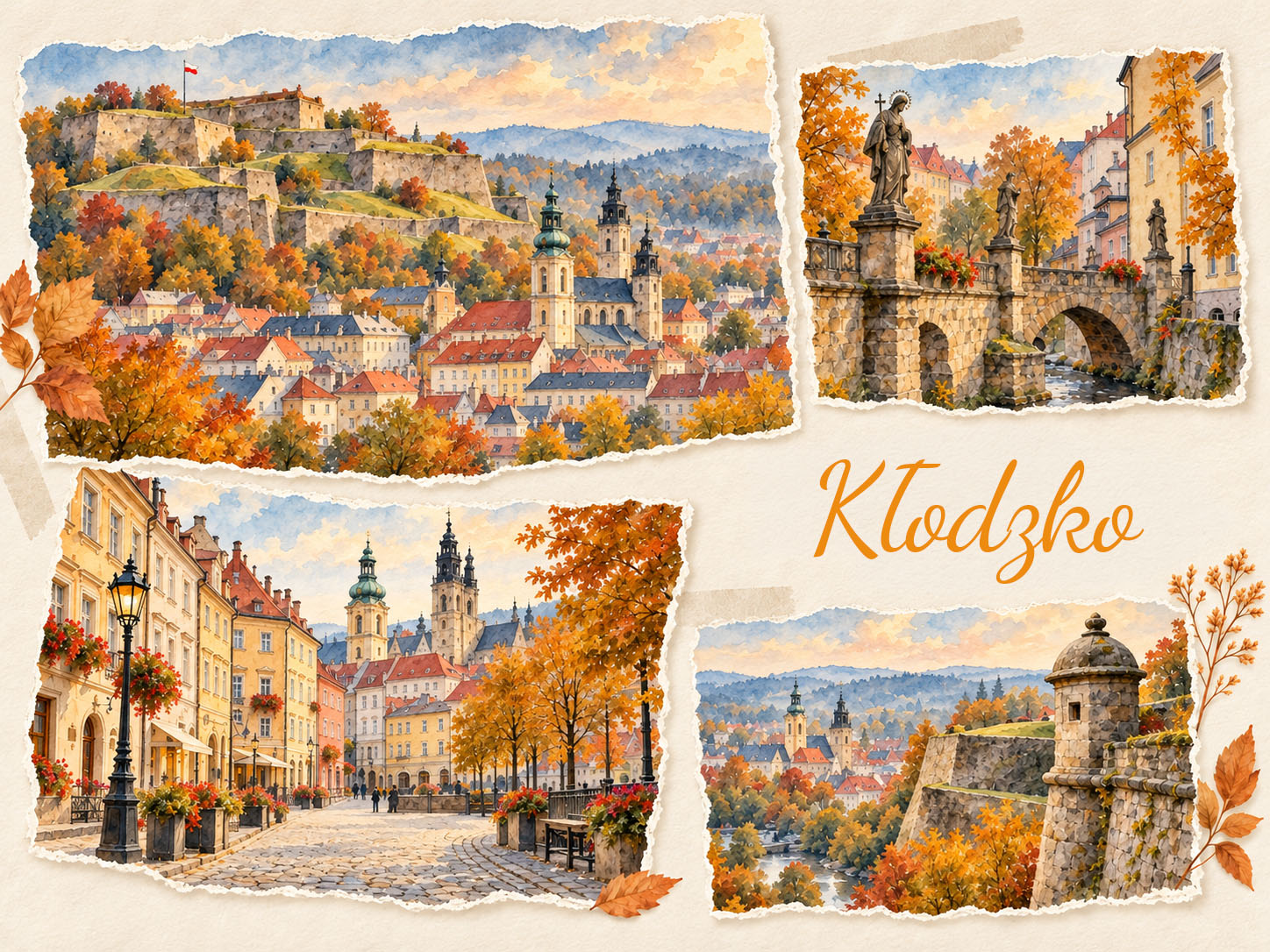
Kłodzko
A town that tells its stories best after dark.

Towards the end of October, some places seem to change their voice. In summer, they speak loudly. In autumn, they whisper. Kłodzko is just such a town.
When the days grow short, cool air settles over the Nysa Kłodzka River, old townhouses catch the last of the light, and the Fortress rises high above the rooftops, it is easy to feel that history is closer here than usual.
There is no need to add ghosts. Kłodzko has more than enough true stories.That is why we are heading here for our last October walk - on a weekend when two very different moods meet: the gentle mystery of Halloween and the quiet remembrance of All Saints’ Day. The town beneath the fortressThe history of the site occupied by today’s Kłodzko Fortress stretches far into the past. The official history of the fortifications gives 981 as the year of the first written mention of a stronghold on Castle Hill.
Over the following centuries, a castle developed here, followed by a mighty system of fortifications. Major expansion took place in the 18th century, when Kłodzko came under Prussian rule.
The Fortress gained extensive bastions, casemates and a network of underground counter-mine passages.
Today, you can explore its grounds and look down over the town, and it is well worth doing because, as you know, the autumn panorama is something special. Red rooftops, towers, the hills of the Kłodzko Valley and trees slowly turning from green through gold to rusty brown.A bridge that has seen more than many a chronicler.
Then it is worth heading down towards the old town to find one of Kłodzko’s landmarks.
The Gothic stone bridge over the MłynówkaIts precise dating is not entirely clear. County sources mention a stone bridge as early as the 13th century, while suggesting that the structure in its present form was probably built towards the end of the 14th century, around 1390. The Baroque statues that adorn it were added later.
On an autumn evening, the bridge looks completely different from how it does in full sunshine. Glowing street lamps, stone, the silhouettes of statues and the town lights in the distance create an incredible atmosphere. But if you are looking for more, you can then head underground. This is where Kłodzko fits the mood of late October perfectly.
Beneath the old town lies an extensive network of old cellars and passages.
They were created over the centuries by the inhabitants of medieval Kłodzko, who needed somewhere to store their goods. Cellars were excavated beneath the closely packed houses and later connected to form an ever larger network.
Today, an approximately 600-metre Underground Tourist Route runs through part of these passages.Goods were once stored here, including Kłodzko’s famous beer, and during conflicts the underground spaces could provide shelter for the townspeople.
Do we need to invent a story about haunted tunnels? No. It is far more interesting to think that, for hundreds of years, above these passages people:

- worked,
- traded,
- argued,
- celebrated,
- raised children
- and simply lived.

And part of their town still lies beneath our feet.Autumn is a good time for remembrance. The beginning of November has a special character in Poland.Cemeteries glow with thousands of memorial candles, we visit the graves of loved ones and slow down for a moment.
Kłodzko suits that mood well. Not because it is “dark”; quite the opposite.
This town reminds us that history is made up of more than the great events recorded in textbooks.
The Fortress was a place of fighting, but during the Second World War it was also a harsh prison, a place of forced labour and arms production. People of various nationalities were imprisoned here.
So, while walking through the fortifications, it is worth pausing sometimes. Not every story needs a legend; some simply need to be remembered.
And Halloween? Perhaps without plastic ghosts, we can approach it with a light touch.
Not as an excuse to search for “the most haunted place in Poland”, but as a time when, a little more than usual, we enjoy: old stories, underground passages, castles, street lamps, mist and places with an air of mystery.
Kłodzko offers all of this without any stage dressing. Simply visit the Gothic bridge after sunset, venture underground or look towards the enormous fortress above the town in the evening. Your imagination will do the rest.And this is where we return to our favourite ritual. Buy a postcard, preferably one showing Kłodzko Fortress, the stone bridge or a panorama of the old town. Then find a café, order something warm and write a few sentences.
There is no need for grand words.
Perhaps:
“Kłodzko in autumn is a little like an old book. The most interesting things begin after dark.”
Or:
“Today, we walked through the town, above the town and beneath the town.”
And that is all.A few days later, someone hundreds of kilometres away will open their letterbox and receive a little piece of autumn in Kłodzko along with the card.
A town for a weekend between light and shadow.In autumn, we do not always need big attractions. Sometimes all it takes is: a warm scarf, a few kilometres of walking, an old town, a cup of hot tea with cloves and a place with something to tell us.
Kłodzko has stories to tell...

- about merchants of the past
- fortifications
- people living above an underground labyrinth
- wars
- about a town whose rulers, borders and languages changed over the centuries, but which still stands beside its river.

And towards the end of October, it tells those stories exceptionally well.

And you? Would you prefer an autumn walk around the Fortress, the Gothic bridge after dark or a descent into Kłodzko’s underground passages?