



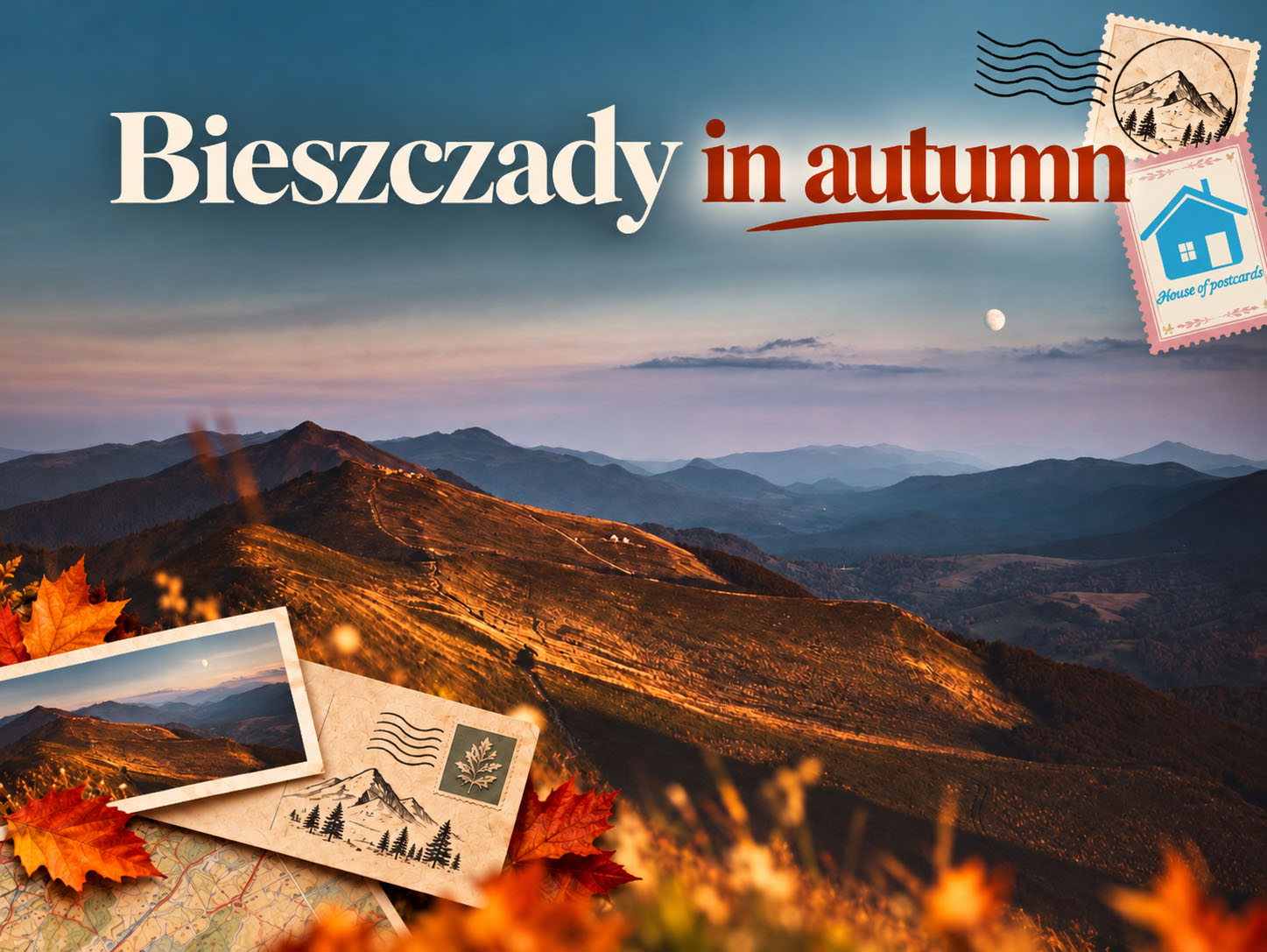
Bieszczady - dropping everything and heading for the Bieszczady MountainsThere are places you visit for the attractions. And there are places you visit for something harder to name. For silence, space, for that moment when you emerge above the treeline, the wind brushes your cheeks a little harder, and the rolling ridge of a mountain meadow comes into view.The Bieszczady Mountains belong firmly to that second category. You do not need to do ten things a day here. Sometimes all it takes is to follow a trail, sit down for a while with a flask, return to Wetlina or Cisna, buy a postcard and write to someone: “Today was beautiful, magical. These views take your breath away..”.This time, in our House of Postcards travel-and-postcard series, we are heading to the far south-east of Poland. To a land of mountain meadows, old beech forests, wooden churches, a forest railway and a sky that can be just as spectacular after dark as the mountains are during the day.We are heading for the Bieszczady. The Bieszczady experience does not begin at the summit.It begins on the road; there is something distinctive about travelling to this region. The further we go, the less there is of everything. Fewer big cities, fewer wide roads, fewer advertisements, and more and more forest, bends, valleys and small villages. The high mountain areas of the Western Bieszczady are protected by Bieszczady National Park, established in 1973. Today, it covers around 29,200 hectares, and its highest point is Tarnica – 1,346 m above sea level.This is where you will find the places most closely associated with the Bieszczady landscape:
- Tarnica,
- Połonina Caryńska,
- Połonina Wetlińska
- Bukowe Berdo
- Wielka Rawka
- Halicz
- The Połoniny
The most distinctive feature of the high Bieszczady is, of course, the połoniny. These are subalpine plant communities found above the upper treeline. Bieszczady National Park highlights an interesting feature of the local vegetation: the Bieszczady lack the upper montane belt of spruce forests typical of many other Polish mountain ranges. The upper treeline consists mainly of stunted, twisted beech trees, with the open expanses of the połoniny beginning above them. That is what makes this landscape so distinctive: the Tatras have towering rock faces and sharp peaks, while the Bieszczady have gentle grassy ridges stretching far towards the horizon. Green in summer, golden in autumn.Połonina CaryńskaOne of the best places for a first encounter with the high Bieszczady is Połonina Caryńska. The official Bieszczady National Park nature trail leads from Ustrzyki Górne to Brzegi Górne and is around 9 kilometres long. The Park gives an average walking time of roughly 3–3.5 hours one way, depending on direction and pace. Once we emerge above the forest, we find exactly what draws people to the Bieszczady: wind, space, rolling ridges and a panorama that even a wide-angle photograph cannot fully capture.Połonina WetlińskaThe full nature trail from Brzegi Górne to Wetlina is around 12.2 km long. The route follows the mountain meadow ridge and passes the famous Chatka Puchatka mountain shelter, before continuing towards Orłowicz Pass and Wetlina. It is worth doing something we often forget during a quick weekend away: slowing down and switching off the phone.TarnicaOf course, there is also Tarnica, at 1,346 metres above sea level, the highest peak in the Polish Bieszczady. The popular trail from Wołosate is around 4.4 km one way, and Bieszczady National Park gives an approximate ascent time of two hours. Tarnica is one of the Park’s most popular destinations. Visitor figures from recent years show that the trail from Wołosate is among the busiest routes in the Bieszczady.Bukowe BerdoIf I were to choose a route for someone who wants to experience the essence of the Bieszczady without necessarily starting with the most obvious option, I would look towards Bukowe Berdo. It is one of those ridges that offer an excellent view of how the mountain ranges fit together. An official Bieszczady National Park nature trail runs through here, and the area itself lies within some of the Park’s most ecologically valuable sections. Walking through the beech forests is particularly beautiful in autumn: first the leaves are still green, then every shade of autumn gradually appears, and it feels magical.UNESCO in the BieszczadyYes, we are briefly returning to a subject that has featured frequently on our blog lately. Because the Bieszczady also have their own connection with World Heritage. Sections of their natural beech forests form part of the transnational UNESCO property “Ancient and Primeval Beech Forests of the Carpathians and Other Regions of Europe”. The entire property currently consists of 93 component parts across 18 countries, while the Polish Bieszczady section comprises four components protecting a combined area of more than 3,400 hectares of beech forest. The Bieszczady are about more than nature. They are also about the traces of former communities in the landscape and the atmosphere of the region. In many valleys, you will see places that now look like wilderness: a meadow, trees, an overgrown road, an old cross, where houses once stood. There were churches, mills, cemeteries and entire communities living here. Materials published by Bieszczady National Park reveal the scale of the loss of local built heritage after the Second World War. Within the boundaries of today’s Park, there were dozens of churches, cemeteries, manor houses, mills and sawmills; a vast proportion of these structures did not survive. That is why walking through the valleys of former villages feels very different from climbing to a mountain meadow: it is about recognising that today’s Bieszczady “wilderness” is partly the result of the region’s deeply difficult history.SmolnikOne place definitely worth visiting is the Church of St Michael the Archangel in Smolnik. It is one of the wooden churches included in the UNESCO property “Wooden Tserkvas of the Carpathian Region in Poland and Ukraine”. The regional tourism website highlights its distinctive Boyko architectural style. Very few examples of this kind have survived in the Bieszczady.The Bieszczady Forest RailwayNot every day in the Bieszczady has to involve walking 15 kilometres. The Bieszczady Forest Railway operates in Majdan near Cisna. Its history dates back to the late 19th century, when narrow-gauge lines were built primarily to transport timber. Today, the railway carries tourists and has become one of the region’s most recognisable symbols.Something important for anyone planning an autumn trip: in October 2026, the railway is still running to Balnica – Tuesday to Friday at 9:30, and on Saturdays and Sundays also at 12:00. The return journey takes around two hours, including a stop in Balnica.SolinaA gondola lift approximately 1.5 km long operates above the dam, and a 55-metre observation tower stands on Mount Jawor. The regional tourism website also states that the gondola lift has the tallest support tower in Poland, measuring 75 metres. In autumn, the views across the water and forest-covered hills can be exceptional.When the sun sets…another side of the Bieszczady comes to life.The Bieszczady Starry Sky Park was established in 2013 to protect the night-time environment from artificial light pollution and encourage astronomical tourism. The Park covers more than 113,000 hectares across Bieszczady National Park and two neighbouring landscape parks. Milky Way viewing events are also being organised here in autumn 2026. If the night is clear, this incredible spectacle is well worth seeing.The Bieszczady and wildlifeThe forests of the Bieszczady are home to species including brown bears, wolves, lynx, wildcats and European bison. All these species are included in conservation documents for Bieszczady National Park and the Bieszczady Natura 2000 site. But an important reminder!The best bear encounter is one you do not have to experience at close range. The Park publishes up-to-date safety guidance concerning bears, and it is worth reading before setting out on a trail. The wilderness of the Bieszczady is beautiful precisely because not everything here exists for visitors. Every season has its own character here, but autumn is rather hard to beat.The beech forests change colour, the grasses on the mountain meadows turn golden, mornings can be misty, and the air has that distinctive sharpness that tells you immediately that summer really is over. It is the perfect time for people who do not want to spend the whole weekend sitting still. A trail in the morning, then coffee in Cisna or Wetlina in the afternoon. Later, the railway, a wooden church or a quieter valley, and stars in the evening. An active autumn does not always have to mean rushing around. In the Bieszczady, it can simply mean spending the whole day surrounded by beautiful natural scenery. Remember that you do not have to see everything on your first visit, and that may be the most important piece of advice. The Bieszczady tempt you to make a plan and see everything in two days. It is not worth it; something of their essence disappears when we try to tick them off a list. Better to choose one good trail, one historic place and one unhurried evening without a plan. Leave something for next time. The Bieszczady are one of those regions where it feels much better to say “I would love to return” than “we have already been there”.We can measure Tarnica’s height, count the kilometres of a trail, give the Park’s area and mark UNESCO churches on a map... but the things that truly capture the Bieszczady begin where the numbers end. In the morning chill before setting out on a trail, in the rustle of leaves, in the empty valley of a former village, in the sight of a little train travelling through the forest. In the stars we can barely see in the city, and in a postcard bought along the way that will arrive in someone’s letterbox a few days later, hundreds or thousands of kilometres from here. Perhaps that is precisely why the Bieszczady and postcards go so well together. You cannot truly appreciate all this in a hurry.And you – if you could choose just one Bieszczady scene for a postcard, what would it be?