


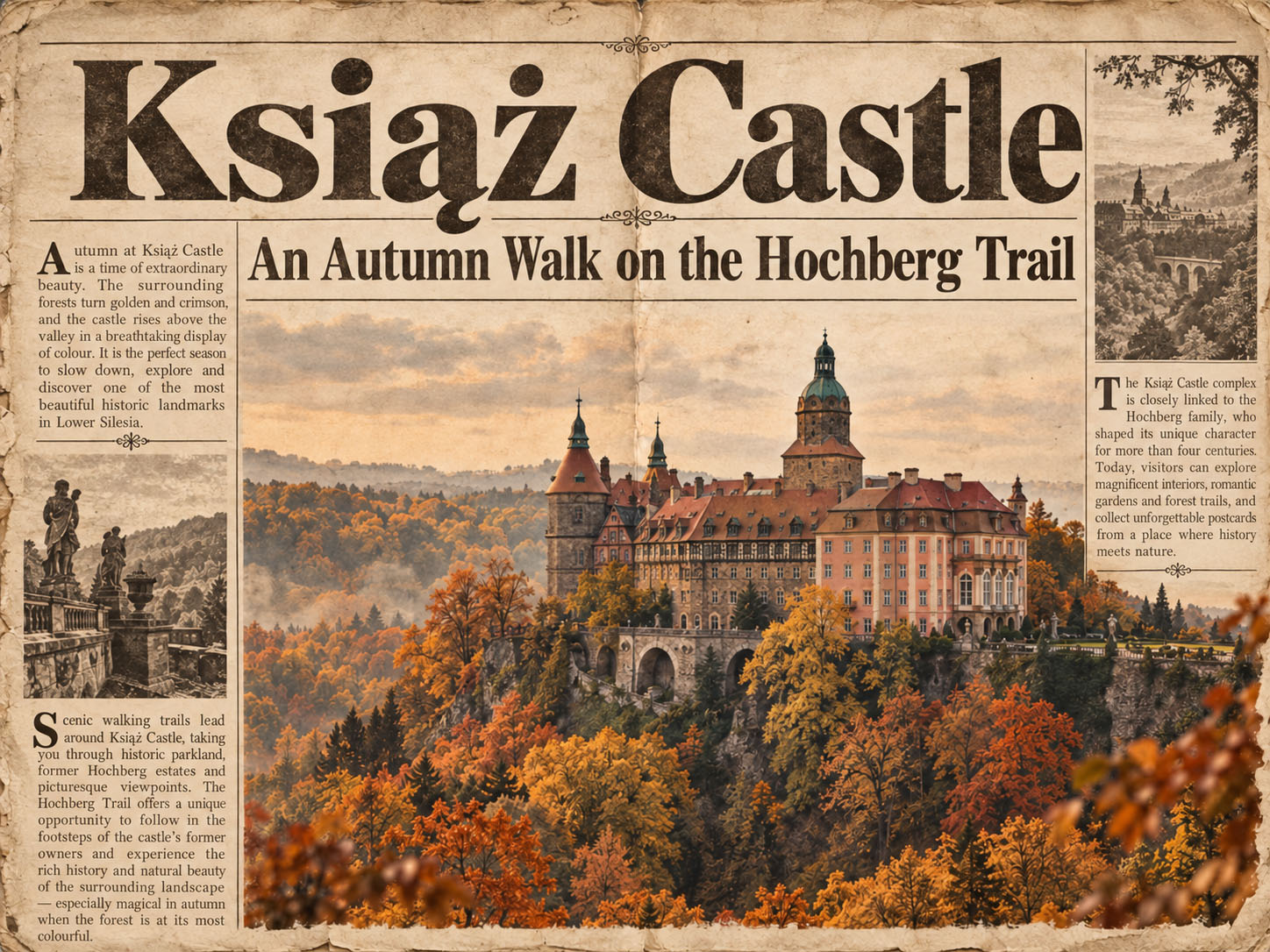
Książ Castle and the Hochberg TrailAutumn has its special places. Places that are beautiful in summer, but only begin to look truly magical in October. Książ Castle is definitely one of them.Perched high above the Pełcznica Valley and surrounded by the forests of Książ Landscape Park, in autumn it becomes a scene filled with gold, rust, red and deep green. And the best part is that you do not have to limit yourself to exploring the castle’s interiors.Around Książ runs the exceptionally picturesque Hochberg Trail – a historic route leading through woodland, rocky slopes, little bridges and the Pełcznica gorges.It is an ideal choice for those who enjoy combining:
- history,
- autumn scenery,
- a few hours of exercise,
- beautiful views
First, the castle. And no ordinary castle! Książ is now recognised as the third-largest castle in Poland. Its origins date back to the 13th century and the reign of Duke Bolko I, but the Hochberg family had the greatest influence on the residence’s appearance and history. The castle’s official history states that Konrad I von Hoberg took possession of Książ in 1509, and the family remained connected with the residence until its confiscation by the Nazis in 1941.
Książ Castle For more than four centuries, the Hochbergs rebuilt the castle, adding grand wings, gardens and features throughout the princely estate. That is why today’s Książ does not represent a single period; it is an architectural chronicle spanning several centuries. Medieval origins, Renaissance, Baroque and major alterations in the 19th and early 20th centuries. Add to that the dramatic history of the Second World War.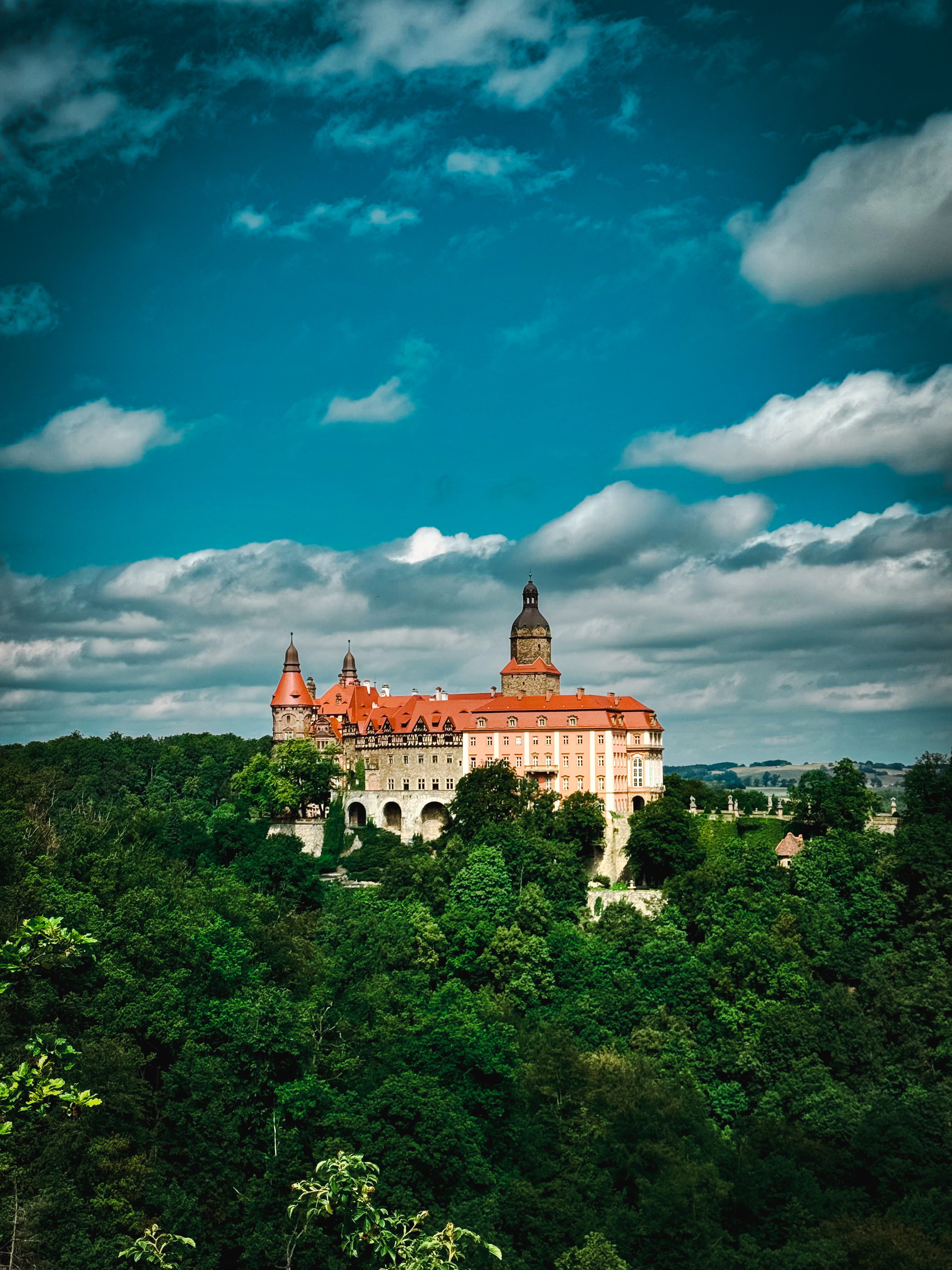 The HochbergsA name you will encounter here at almost every turn. Książ owes much of its grandeur to this family. One of its best-known members was Hans Heinrich XV, whose wife was Mary Theresa Olivia Cornwallis-West – known to everyone interested in the history of Książ as Princess Daisy. To this day, Daisy remains one of the most recognisable figures associated with the castle. It was also with her in mind that Hans Heinrich XV created the nearby Palm House. Official Książ Castle materials state that construction began in the early 20th century; it was intended as a special gift for the princess, who loved flowers and exotic plants. So, if the weather starts to turn after your autumn walk, the Palm House makes an excellent addition to the trip. Outside, it is October; inside – palm trees and a touch of the exotic.
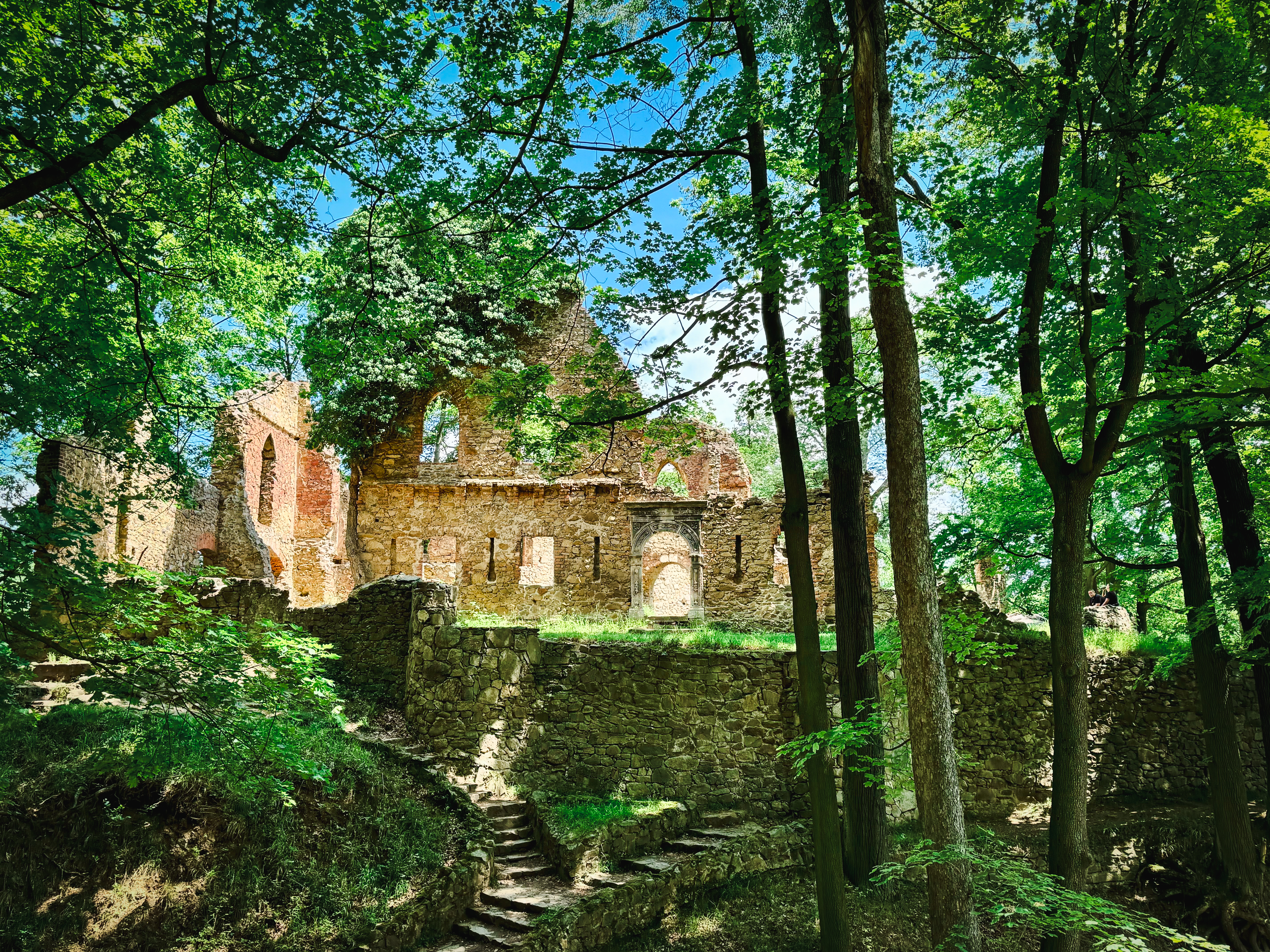
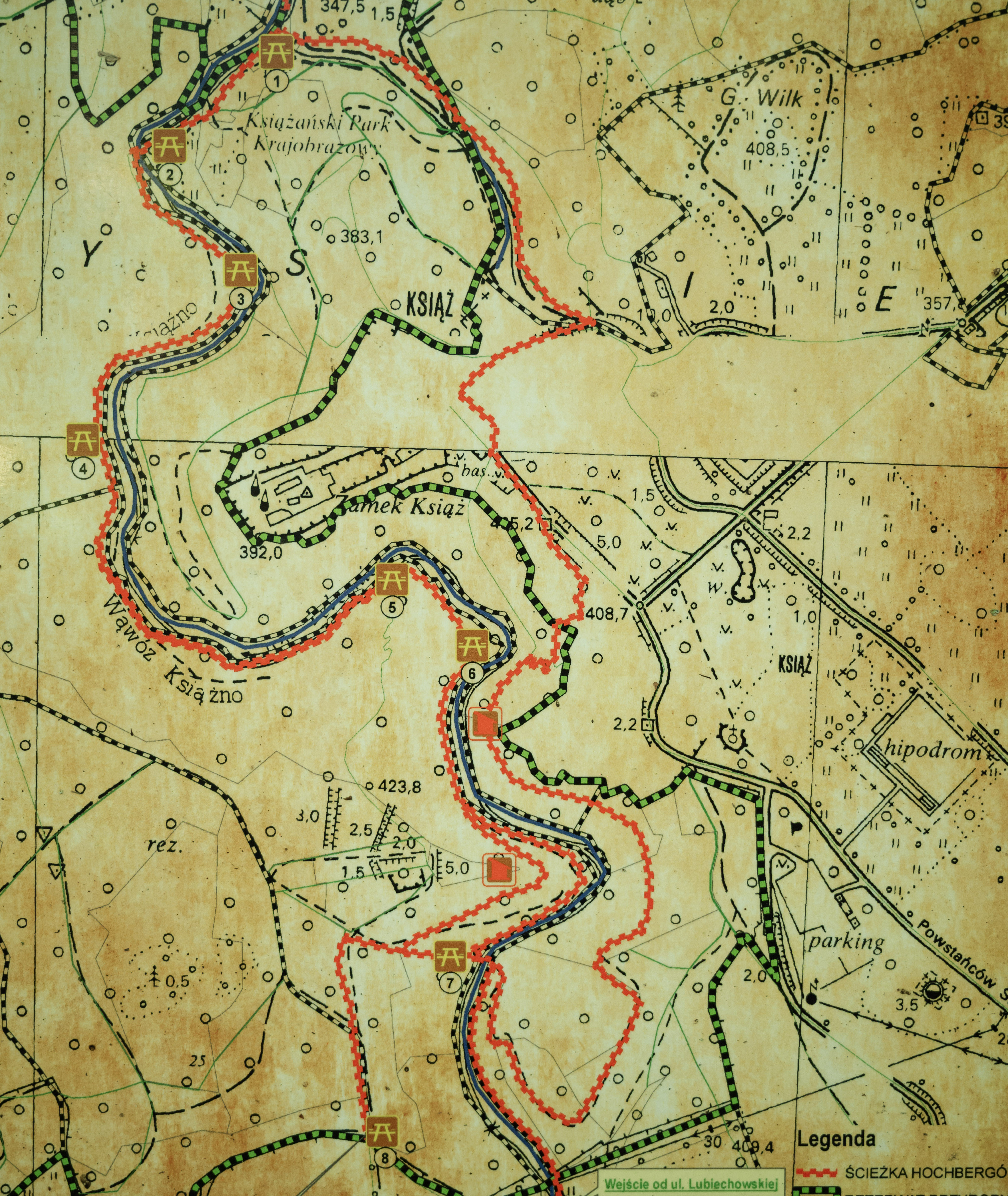 The castle is surrounded by Książ Landscape Park, whose most spectacular section is the “Przełomy pod Książem koło Wałbrzycha” nature reserve. The reserve protects the gorge sections of the Pełcznica and Szczawnik rivers, along with an exceptionally rich variety of flora and fauna. Its steep slopes and deeply carved valleys sometimes make it hard to believe that we are still right next to Wałbrzych.The trail follows sections of the gorge’s edge, then descends towards the Pełcznica, crosses little bridges, wooden footbridges and steps, before climbing back up among the trees. A popular walking route taking in the surroundings of Książ, Old Książ Castle and the gorges is around 10 kilometres long, and it is worth allowing about 3–4 hours to complete it at a leisurely pace. The exact distance naturally depends on your starting point and chosen route. It is not an extreme mountain trail, but it is certainly not a stroll along a flat promenade either.Why does autumn suit this place so well?Because the Hochberg Trail leads through woodland, and autumn completely transforms the route. The tree canopies cover the slopes in shades of yellow, orange, red, brown and the last traces of summer green. The Pełcznica flows below, the path climbs high above the gorge before descending almost to river level, and rock faces appear between the trees from time to time. It is in precisely these surroundings that you begin to understand why the aristocracy of the past needed no additional attractions here. The Giant’s HeadOne of the most popular viewpoints near the castle is a place known as the Giant’s Head or the Giant’s Grave. It offers one of the characteristic views of Książ surrounded by forests. The spot also has a local legend about a giant whose head supposedly became fused with the rock over time. Let us treat the legend as part of local folklore, of course, but the view is particularly striking in autumn. This is one of those places where it is worth forgetting about the time and simply staying for a while.Old Książ Castle (a castle designed to look… older than it actually was)This is one of the most interesting stories of the entire trip. Following the Hochberg Trail, you can reach the ruins of Old Książ Castle, and the name might suggest that it is much older than Książ Castle itself. But here comes the surprise. Much of the Old Książ complex was only created in the late 18th century on the initiative of Hans Heinrich VI Hochberg. It was a Romantic interpretation of medieval ruins – in keeping with the fashion of the time for creating picturesque “ancient” structures in landscaped parks. In modern terms, the Hochbergs created their own medieval retro retreat.Today, romantic ruins are all that remain of the structure.In autumn, surrounded by colourful woodland and fallen leaves, they look exactly as romantic ruins should - a little mysterious.
 The PełcznicaThe Pełcznica accompanies us along much of the route. It may not be a large river, but its role in shaping the surrounding landscape is enormous. The deep gorges of the Pełcznica and its tributary, the Szczawnik, are the main reason this area is protected. The “Przełomy pod Książem koło Wałbrzycha” nature reserve was established in 2000 specifically to preserve this exceptional landscape and the diversity of plants and animals found here.This is a decidedly wilder area, and that is precisely what makes it so interesting.
Footbridges, steps, rocksOne of the things that most surprises first-time visitors to the Hochberg Trail is the nature of the route. In places, it follows a narrow stretch of hillside, with wooden footbridges, railings and steps. You have to descend to the valley floor, only to start climbing again a little later. This is what makes the trip more interesting than an ordinary woodland walk, but in autumn you need to use common sense. After rain, wet stones, roots and leaves can be slippery. If the weather is really poor, it is better to choose a shorter route than insist on completing the whole trail at any cost. An active autumn should be enjoyable, not a survival test.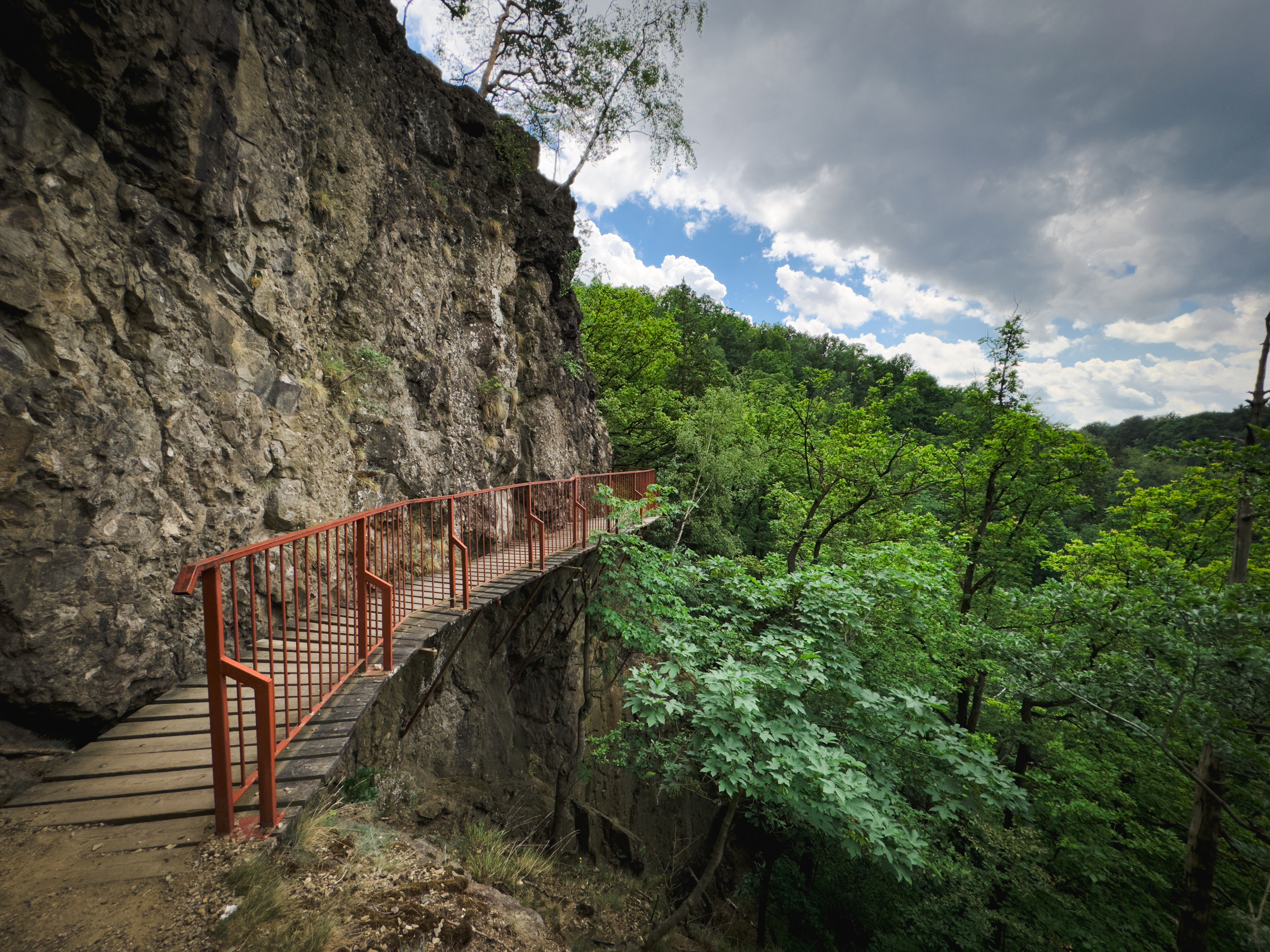 The Bolko YewAlong the way, you can also see one of the best-known natural monuments near Książ – the Bolko yew. Its age is estimated at roughly 400–600 years. When the Hochbergs took possession of Książ in the early 16th century, the tree was probably already growing. Borders, owners and eras changed, the castle was rebuilt, and the yew still stands.If the weather is fine, it is worth making Książ the starting point for a full day of activity. You can combine:
- a tour of the castle,
- a walk lasting several hours,
- Old Książ Castle,
- viewpoints.
Książ Castle itself also actively promotes autumn as a good time to visit, highlighting the combination of the castle’s history and the golden colours of the surrounding forests.And when it starts raining, and autumn does what autumn does.... we have a plan B. We can spend more time inside the castle, then head to the Palm House.If the sun comes out in the afternoon, it is time to put our walking shoes on and return to the forest.So, if this autumn you are looking for a place that combines sightseeing with a proper walk, history with nature, and beautiful views with a little adventure – Książ and the Hochberg Trail definitely deserve a place on your list.
And you? Did you already know about the Hochberg Trail, or had you mainly associated Książ with visiting the castle until now?Source: House of Postcards Archive