



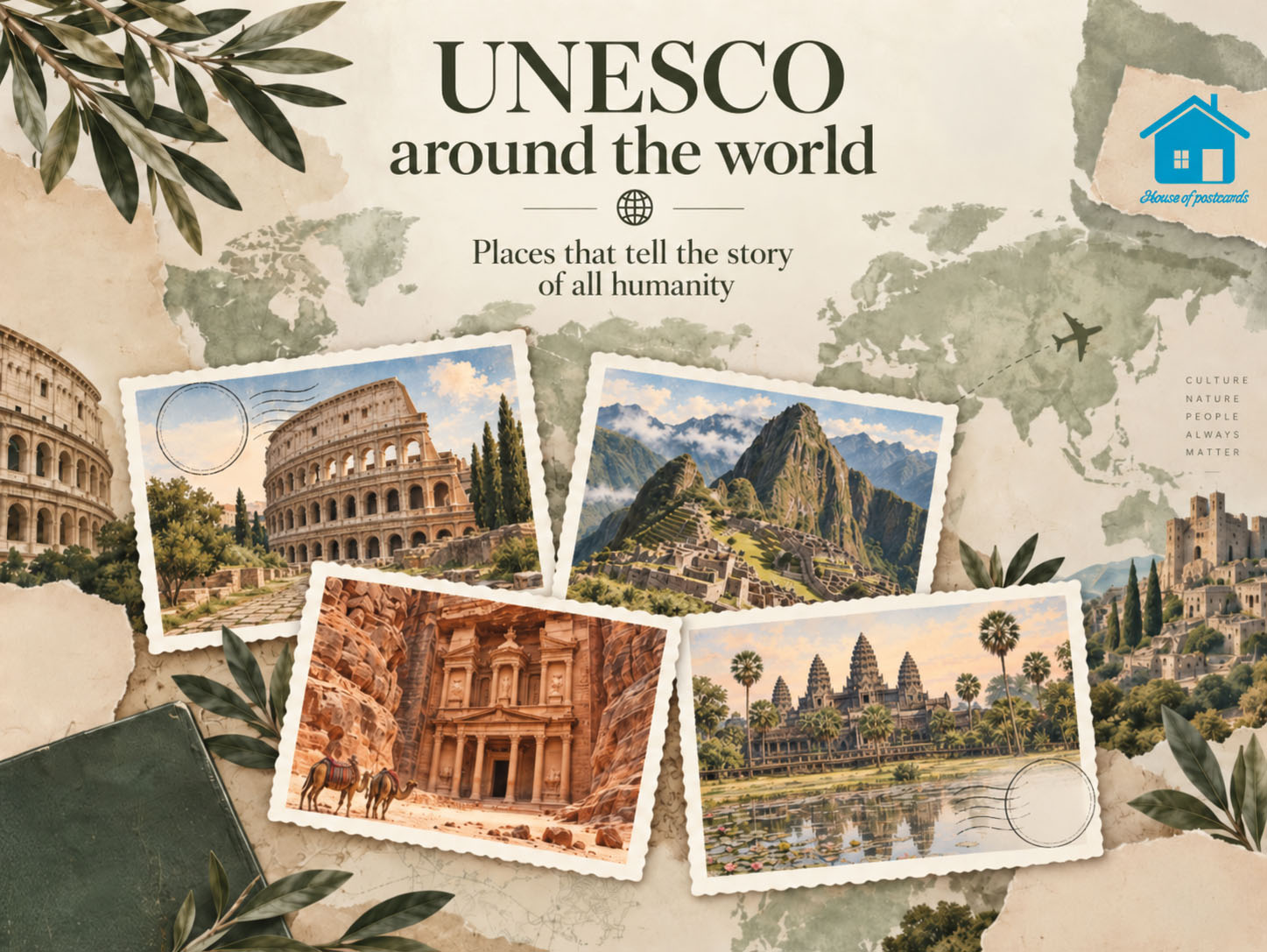
UNESCO around the world – places that tell the story of all humanity
There are places we look at and think: “beautiful”. There are places where we take a hundred photos. And then there are places whose significance reaches far beyond the borders of a single city or country.
- The Great Wall of China
- Galapagos
- Machu Picchu
- Petra
- Serengeti
- Venice
- Stonehenge
- Great Barrier Reef
At first glance, they do not seem to have much in common. Some were created by nature. Others by humans. Some are thousands of years old, while others were created relatively recently. Some are vast landscapes, others individual groups of buildings. Yet they all have one thing in common - UNESCO has recognised that their value is important not only to one country, but to all of humanity.After our journey through Poland’s UNESCO sites, it is time to take a much bigger step. This time, we are travelling around the world.
First, the numbers. How many UNESCO sites are there in the world?According to the current UNESCO World Heritage List, following the Committee session in 2026, there are 1273 properties on the list.Among them are:
- 991 cultural properties,
- 240 natural properties,
- 42 mixed properties, meaning they possess both outstanding cultural and natural value.
UNESCO sites are currently located in 173 countries, while 51 properties are transboundary or transnational. 58 properties are currently listed as World Heritage in Danger. These numbers alone show that describing all of them in a single post would be material for a book rather than an article.That is why we are choosing places that show particularly well just how diverse UNESCO World Heritage can be.
But what does a place actually have to do to make it onto the list?Being old is not enough, being famous is not enough and even being exceptionally beautiful does not guarantee inscription.A property must possess what is known as Outstanding Universal Value and meet at least one of UNESCO’s 10 criteria. Authenticity or integrity, as well as the way the site is protected and managed, are also taken into account.The criteria include, among other things, masterpieces of human creative genius, exceptional testimonies to past cultures, important stages in the history of the Earth, extraordinary natural phenomena or habitats that are crucial for preserving biological diversity.UNESCO does not create a list of the most beautiful places in the world, it creates an enormous archive of what humanity and nature have created that is exceptional and worth preserving for future generations.
The Convention concerning the Protection of the World Cultural and Natural Heritage was adopted in 1972, but the first properties were added to the list six years later. It all began with… 12 places that we mentioned in our previous post, and now we move on.
Galapagos Islands – EcuadorIf we are looking for a place that truly changed the way people thought about the natural world, it is difficult to start anywhere else. The archipelago, located around 1000 km off the coast of South America, developed for thousands of years in extraordinary isolation. It was the remarkable wildlife of the Galapagos – including giant tortoises, iguanas and finches – that provided one of the important impulses for Charles Darwin’s thinking about evolution after his visit in 1835. UNESCO even describes the Galapagos as a “living museum and showcase of evolution”.Interesting fact: Galapagos was given dossier number 1 in the UNESCO system. This does not mean it was the only “first” property – all 12 original sites were inscribed during the same session – but the number certainly looks impressive on a collector’s UNESCO list.
Quito – EcuadorThe second Ecuadorian property among the original twelve was Quito. The city lies high in the Andes – at around 2800 metres above sea level.UNESCO emphasises that its historic centre is one of the best preserved and least altered historic centres in Latin America. Particularly interesting is the local Baroque school, where European influences were combined with the traditions of Indigenous peoples.
Yellowstone – USAWe usually associate Yellowstone with geysers, but the numbers truly reveal the scale of this place. UNESCO states that there are more than 10,000 geothermal features here and more than half of the world’s known active geysers, while the park covers almost 9000 km². It is also home to grizzly bears, wolves, bison and elk.
Machu Picchu – PeruHere, UNESCO protects more than just the famous Inca ruins. Machu Picchu is a mixed property – it possesses both outstanding cultural and natural value. The Inca city lies at an altitude of around 2430 m above sea level, at the meeting point of the Andes and the upper Amazon Basin. UNESCO regards it as one of the greatest architectural and urban achievements of the Inca civilisation and perhaps this combination is exactly what makes the strongest impression - people created an extraordinary city, but the surrounding landscape is an equally important part of the site.
Qhapaq Ñan – six South American countriesThis is one of the most surprising UNESCO inscriptions. Qhapaq Ñan is not a single monument, but a vast Andean road system developed by pre-Hispanic communities and later by the Incas. The entire network extended for more than 30,000 kilometres and crossed present-day Argentina, Bolivia, Chile, Colombia, Ecuador and Peru. It connected coastlines, deserts, forests and mountain passes located more than 6000 metres above sea level.
Rapa Nui – ChileEaster Island - Moai and far more history than the most famous photographs reveal.UNESCO states that the island is home to around 900 monumental statues and more than 300 ceremonial platforms. The moai themselves vary greatly in size – from around 2 to as much as 20 metres high. The largest group of standing statues can be found at Ahu Tongariki – 15 moai stand there.Even more interestingly, the national park inscribed on the UNESCO list covers around 40% of the entire island.
The Great Wall of China – ChinaOne of the most recognisable structures in the world, but forget for a moment about the idea of one single wall stretching from one end of China to the other.The Great Wall is a complex system of fortifications created during different historical periods. It consists not only of walls, but also towers, forts, passes and roads.According to UNESCO, the entire system extends for more than 20,000 kilometres. It was built from the 3rd century BC until the 17th century.
Angkor – CambodiaAlmost everyone knows Angkor Wat, but the UNESCO property includes much more.Angkor Archaeological Park covers around 400 km² and contains the remains of successive capitals of the Khmer Empire dating from the 9th to the 15th century. There are not only temples here, but also:
- reservoirs,
- canals,
- dams,
- roads,
- extensive water infrastructure.
It is this infrastructure that reminds us that Angkor was not merely a place of worship. It was a powerful, complex urban organism.
Taj Mahal – IndiaOne of the most romantic buildings in the world was actually created as a monumental tomb. Shah Jahan began its construction in the 17th century in memory of his wife Mumtaz Mahal. The main mausoleum was completed in 1648, with other parts of the complex finished several years later.Interesting fact: the Taj Mahal does not stand in the centre of the garden, the mausoleum was placed at one end of it – UNESCO points to this as one of the innovative solutions of the entire design, creating an extraordinary sense of depth and perspective.
Petra – JordanThe Treasury carved into rose-coloured rock is spectacular, but Petra’s genius also lies in something that is almost invisible in photographs. The Nabataeans created an extremely sophisticated water management system:
- canals,
- cisterns,
- reservoirs,
- dams.
Thanks to it, a large city could function in an extremely dry environment. Petra was also an important point on trade routes connecting Arabia, Egypt and Syria.
Lalibela – EthiopiaEleven churches carved directly into solid rock, cut from the top down. They were created as a kind of “New Jerusalem” and remain a pilgrimage destination for Ethiopian Christians to this day.One of the buildings – Biete Medhani Alem – is, according to UNESCO, probably the largest monolithic church in the world, while the cross-shaped Church of St George is among the most extraordinary sacred buildings in Africa.
Timbuktu – MaliToday, the name Timbuktu is sometimes used almost as a synonym for “very far away”. Yet for centuries it was one of Africa’s great intellectual centres.In the 15th and 16th centuries, around 180 Quranic schools operated here, while the number of students may have reached 25,000. Manuscripts were also traded here, and the city was an important point on trans-Saharan trade routes. UNESCO protects, among other things, three great mosques and mausoleums that recall the period when Timbuktu was one of the centres of learning in the Islamic world.
Serengeti – TanzaniaOne of the most spectacular natural places on Earth. Every year, around two million wildebeest move through the Serengeti ecosystem, accompanied by hundreds of thousands of zebras and gazelles, and of course predators follow them as well.UNESCO describes this journey as the largest remaining largely unaltered migration of large terrestrial animals in the world. Its route may extend for around 1000 km.
Victoria Falls – Zambia and ZimbabweThe local name Mosi-oa-Tunya means “the smoke that thunders”. When we look at the numbers, it is not difficult to understand why. The waterfall is around 1708 metres wide, and the cloud of spray rising above it can be visible from dozens of kilometres away. UNESCO describes it as the world’s largest curtain of falling water.
Great Barrier Reef – AustraliaThe area inscribed on the UNESCO World Heritage List covers around 348,000 km².UNESCO lists around:
- 400 types of coral,
- 1500 species of fish,
- 4000 species of molluscs.
It is the largest coral reef ecosystem in the world.
K’gari – AustraliaFormerly more widely known as Fraser Island. It is 122 km long and is the largest sand island in the world.Tall rainforests grow on enormous sand dunes, and the island contains around half of the world’s known freshwater dune lakes known as perched lakes.UNESCO also points out that the island contains the largest known unconfined aquifer on a sand island.
Stonehenge and Avebury – United KingdomStonehenge is more famous, but the UNESCO inscription also includes Avebury and numerous other prehistoric sites.Interesting fact: Avebury has the largest prehistoric stone circle in the world. Stonehenge, meanwhile, is described by UNESCO as the most architecturally sophisticated prehistoric stone circle in the world.Some of its so-called bluestones were transported from as far as around 240 kilometres away. Several thousand years ago, without trucks - that was quite a challenge.
Venice and its Lagoon – ItalyUNESCO Venice is not just St Mark’s Square and the Grand Canal. The inscription includes both the city and the entire lagoon. Historic Venice developed on 118 small islands, which over time were connected into a unique urban system intersected by canals.UNESCO treats the city and lagoon as an inseparable whole and perhaps few places in the world demonstrate so clearly that a cultural landscape can emerge through cooperation between people and an extremely challenging natural environment.
Acropolis of Athens – GreeceThe Parthenon is only part of the whole. The Acropolis is a group of buildings that UNESCO describes as a symbol of the classical spirit and civilisation of Greece. Its most important monuments were built in the 5th century BC during the time of Pericles.Interesting fact: the fortifications surrounding the hill have a history stretching back more than 3300 years, meaning that long before the Parthenon was built, the site already had a very long history.
Vatican CityThis is probably one of the most unusual entries on the entire list. The boundaries of the UNESCO property coincide with the entire territory of Vatican City State.So in this case, it can be said that the entire country is a World Heritage Site.It covers an area of only around 44 hectares.
- St Peter’s Basilica,
- Sistine Chapel,
- palaces,
- museums
- gardens
Struve Geodetic Arc – 10 countriesThese are preserved points from historical geodetic measurements. The Struve Arc extended for 2820 km from northern Norway towards the Black Sea.Originally, it consisted of 265 main survey points. UNESCO protects 34 of them in 10 countries.In the 19th century, these measurements made it possible to determine the size and shape of the Earth much more accurately.Some UNESCO points are simply small holes drilled into rock.
UNESCO does not mean “untouchable forever”. This is one of those facts that is discussed far less often - a property can lose its UNESCO status.So far, this has happened three times. The current UNESCO database lists three properties that have been removed from the World Heritage List.The most recent was Liverpool – Maritime Mercantile City in 2021. UNESCO concluded that new developments had caused an irreversible loss of the characteristics that gave the site its outstanding value. Earlier, the Dresden Elbe Valley and the Arabian Oryx Sanctuary in Oman also lost their status.So the UNESCO label is not an award granted once and forever, it is also a responsibility.
10 UNESCO facts worth remembering!
- The first World Heritage List in 1978 contained only 12 sites
- Today there are 1273
- Galapagos has UNESCO dossier no. 1
- Yellowstone contains more than half of the world’s known active geysers
- The entire Great Wall of China system extends for more than 20,000 km
- Qhapaq Ñan formed a network of more than 30,000 km of roads running through six present-day countries
- The Struve Geodetic Arc includes 34 protected points in 10 countries
- All 44 hectares of Vatican City form a UNESCO World Heritage property
- K’gari is the largest sand island in the world
- So far, only three properties have been completely removed from the World Heritage List.
And now a question for you:which UNESCO site in the world would you most like to see with your own eyes?