


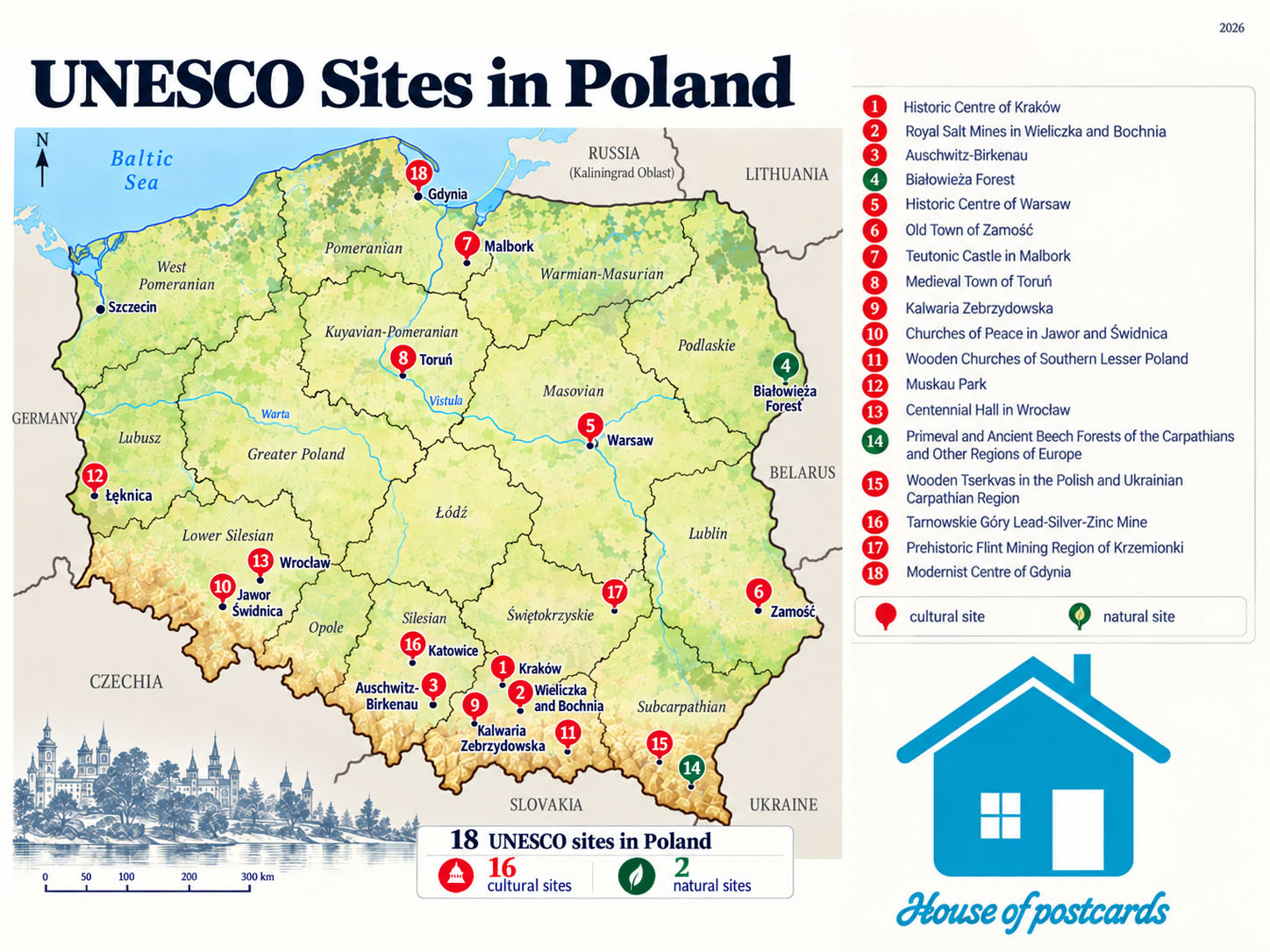
Poland on the UNESCO List – 18 places known around the world
Kraków, the Białowieża Forest, the salt mine, wooden Orthodox churches, Malbork Castle… and Gdynia, the newest addition to the list. Some were created hundreds of years ago. Others represent 20th-century architecture. Some were created by humans, while others were shaped by nature. Millions of tourists visit them every year, and they all have one thing in common – they have been included on one of the world’s most prestigious lists: the UNESCO World Heritage List.
At House of Postcards, we love discovering Poland not only while travelling, but also… through postcards, so we decided to take a closer look at these places. Especially since 2026 has given us a great reason to start this series right now – Poland has a new site on the UNESCO list.
But let’s start at the beginning.
UNESCO
The abbreviation UNESCO stands for United Nations Educational, Scientific and Cultural Organization. One of UNESCO’s most widely recognised initiatives is the World Heritage List. However, it is not a ranking of the world’s most beautiful monuments. To be included on the list, a site must possess what is known as Outstanding Universal Value. In other words, its significance should extend beyond the borders of a single country and be important to humanity as a whole. That is why, alongside monumental buildings, the list also includes landscapes, forests, archaeological sites, historic cities and monuments of technology and industry.
Poland ratified the World Heritage Convention in 1976, and we did not have to wait long for the first Polish sites to be added to the list.
It all began in 1978 – and this is a particularly interesting part of the story.
The first UNESCO World Heritage List was announced in 1978. It included just 12 sites from around the world.
They were:
1. Galápagos Islands – Ecuador
2. City of Quito – Ecuador
3. Rock-Hewn Churches of Lalibela – Ethiopia
4. Simien National Park – Ethiopia
5. L’Anse aux Meadows (Viking site) – Canada
6. Nahanni National Park – Canada
7. Aachen Cathedral – Germany
8. Wieliczka Salt Mine – Poland
9. Historic Centre of Kraków – Poland
10. Island of Gorée – Senegal
11. Mesa Verde National Park – United States
12. Yellowstone National Park – United States
How many UNESCO sites are currently located in Poland?
There is a little catch here. If you type this question into a search engine, you may still find the answer: 17. Until recently, that was indeed correct.
But since 2026, Poland has had 18 entries on the UNESCO World Heritage List. The newest one is the Modernist City Centre of Gdynia (Gdynia Modernist City Centre). UNESCO’s official database currently classifies Poland’s inscriptions as 16 cultural and 2 natural sites.
And here comes another interesting fact, because “18 sites” does not necessarily mean eighteen individual buildings. A single UNESCO inscription may include several or even many different locations.
A good example is the Churches of Peace in Jawor and Świdnica – one UNESCO inscription, but two separate churches.
The same applies to the Wooden Churches of Southern Małopolska or the Wooden Tserkvas of the Carpathian Region. That is why the number of places that can actually be visited while travelling in the footsteps of UNESCO is much greater than 18.
18 Polish UNESCO treasures
1. Historic Centre of Kraków – 1978
Kraków was among the first 12 sites inscribed on the UNESCO World Heritage List. The inscription includes the medieval Old Town, Wawel and Kazimierz, and its exceptional value comes from its remarkably well-preserved urban layout and extraordinary concentration of monuments representing successive historical periods.
2. Royal Salt Mines in Wieliczka and Bochnia – first inscription 1978
This is an exceptional testimony to the development of European salt mining from the 13th all the way to the 20th century. UNESCO recognizes both the kilometres of underground workings and the chambers, chapels, salt sculptures, historic mining equipment and the connection between the mines and the Saltworks Castle in Wieliczka.
3. Auschwitz-Birkenau – 1979
This site was inscribed primarily as a testimony to the Holocaust and Nazi crimes and as one of the most important places of remembrance of the 20th century. The preserved barracks, fences, ramps, gas chambers and crematoria are material evidence of the functioning of the German Nazi concentration and extermination camp.
4. Białowieża Forest – first inscription 1979
This transboundary property shared by Poland and Belarus protects a vast complex of natural lowland forests of exceptional importance for biodiversity. The forest is also home to the largest population of European bison associated with this UNESCO property.
5. Historic Centre of Warsaw – 1980
Warsaw was recognized by UNESCO not only because of its monuments, but above all as an exceptional example of the almost complete reconstruction of a historic city. After more than 85% of the historic centre was destroyed in 1944, the Old Town was meticulously rebuilt after the war.
6. Old City of Zamość – 1992
Zamość is one of the finest examples of the Renaissance concept of the “ideal city”. Founded by Jan Zamoyski and designed by Bernardo Morando, it has preserved its original urban layout, fortifications and architecture combining Italian and Central European influences.
7. Castle of the Teutonic Order in Malbork – 1997
Malbork is one of the most outstanding examples of medieval brick architecture associated with the Teutonic Order. UNESCO also highlights the history of its conservation – restoration work carried out here in the 19th and 20th centuries influenced the development of modern methods of monument preservation.
8. Medieval Town of Toruń – 1997
Toruń has preserved an exceptionally clear medieval urban layout associated with the Teutonic Order and Hanseatic trade. Numerous Gothic buildings in the Old and New Towns demonstrate Toruń’s significance as one of the important commercial centres of medieval Europe.
9. Kalwaria Zebrzydowska – 1999
Here, UNESCO recognized not a single building, but an entire cultural landscape combining architecture, nature and religious tradition. Chapels and places of worship connected with the Passion of Christ and the life of the Virgin Mary, scattered among the hills, form a pilgrimage park that has remained almost unchanged since the 17th century.
10. Churches of Peace in Jawor and Świdnica – 2001
These are the largest timber-framed religious buildings in Europe. Built in the 17th century after the Thirty Years’ War, they are an extraordinary testimony to the history of Protestantism, the restrictions imposed on Lutherans and the pursuit of religious freedom.
11. Wooden Churches of Southern Małopolska – 2003
The inscription includes six exceptionally well-preserved Gothic churches in Binarowa, Blizne, Dębno Podhalańskie, Haczów, Lipnica Murowana and Sękowa. They are outstanding examples of the medieval tradition of wooden church construction within Roman Catholic culture.
12. Muskauer Park / Park Mużakowski – 2004
This is a transboundary landscape park located on both sides of the Lusatian Neisse, in Poland and Germany, designed in the 19th century by Prince Hermann von Pückler-Muskau. UNESCO recognized it as a groundbreaking work of landscape architecture that later influenced park design in Europe and America.
13. Centennial Hall in Wrocław – 2006
The hall, designed by Max Berg and built between 1911 and 1913, was a pioneering achievement in reinforced-concrete construction. UNESCO emphasizes its importance as one of the key milestones in the development of modern 20th-century architecture and engineering.
14. Ancient and Primeval Beech Forests of the Carpathians and Other Regions of Europe
This vast international property currently consists of 93 component parts in 18 countries, including Poland. It protects exceptional examples of natural beech forests and illustrates the remarkable process of the spread of European beech across the continent since the end of the last Ice Age.
15. Wooden Tserkvas of the Carpathian Region in Poland and Ukraine – 2013
The inscription includes 16 wooden tserkvas on both sides of the Polish-Ukrainian border, built between the 16th and 19th centuries by Orthodox and Greek Catholic communities. They are an exceptional testimony to the sacred architectural tradition of the Carpathians, combining Eastern church architecture with local building techniques.
16. Lead-Silver-Zinc Mine and its Underground Water Management System in Tarnowskie Góry – 2017
This is an extraordinary industrial heritage site, most of which is located underground. UNESCO recognizes the extensive network of shafts, adits and galleries, as well as the mine drainage system, which for centuries not only made mining possible but also supplied water to towns and industry.
17. Krzemionki Prehistoric Striped Flint Mining Region – 2019
Krzemionki is a complex of four sites associated with the extraction of striped flint from approximately 3900 to 1600 BC. Thousands of shafts, underground workings and areas where the raw material was processed have survived here, creating one of the best-preserved prehistoric mining systems in the world.
18. Modernist City Centre of Gdynia – 2026
Poland’s newest UNESCO inscription shows how, during the interwar period, the small town of Gdynia was transformed into a modern port city. The preserved city centre, with its modernist apartment buildings, public buildings and villas, is an example of applying the ideas of modernism on the scale of an entire city and a symbol of the move away from historicist forms of architecture.
This list alone shows just how diverse Poland’s heritage is. We have beautiful places, but also places whose significance comes from the need to preserve the memory of the most tragic events in history. We also have UNESCO… underground. Wieliczka and Bochnia tell the story of salt mining, while Tarnowskie Góry tells the story of lead, silver and zinc mining and its extraordinary water-management system. Krzemionki, meanwhile, takes us even further back in time – to prehistoric striped flint mines.
UNESCO that cannot be contained within the borders of a single country
Not all Polish UNESCO inscriptions belong exclusively to Poland. Several of them are shared with other countries. Muskauer Park / Park Mużakowski is a transboundary property shared by Poland and Germany, while the inscription covering the Ancient and Primeval Beech Forests of the Carpathians and Other Regions of Europe is a vast international property spanning areas in many European countries. It is a beautiful reminder that heritage does not always concern itself with borders drawn on a map.
Of Poland’s 18 UNESCO inscriptions, 16 are cultural and two are natural. One of them is, of course, the Białowieża Forest. The other is the international inscription covering the Ancient and Primeval Beech Forests of the Carpathians and Other Regions of Europe. We also have UNESCO… underground
Wieliczka and Bochnia tell the story of salt mining, while Tarnowskie Góry tells the story of lead, silver and zinc mining and its extraordinary water-management system. Krzemionki, meanwhile, takes us even further back in time – to prehistoric striped flint mines.
Warsaw was placed on the list for an extraordinary reason
Warsaw’s Old Town looks historic, but a huge part of what we see today was painstakingly rebuilt after the destruction of World War II. It is precisely the scale and quality of this reconstruction that are crucial to its UNESCO inscription. The Historic Centre of Warsaw was added to the list in 1980 as an exceptional example of the almost complete reconstruction of a historic urban ensemble. This means that a postcard showing Warsaw’s Old Town represents something much more than a beautiful market square because it tells the story of a city that was destroyed and later recreated.
And now a question for you:
How many of Poland’s 18 UNESCO sites have you already seen with your own eyes, and how many of them do you have on postcards?
Source: the official UNESCO World Heritage List, as of September 2026.