


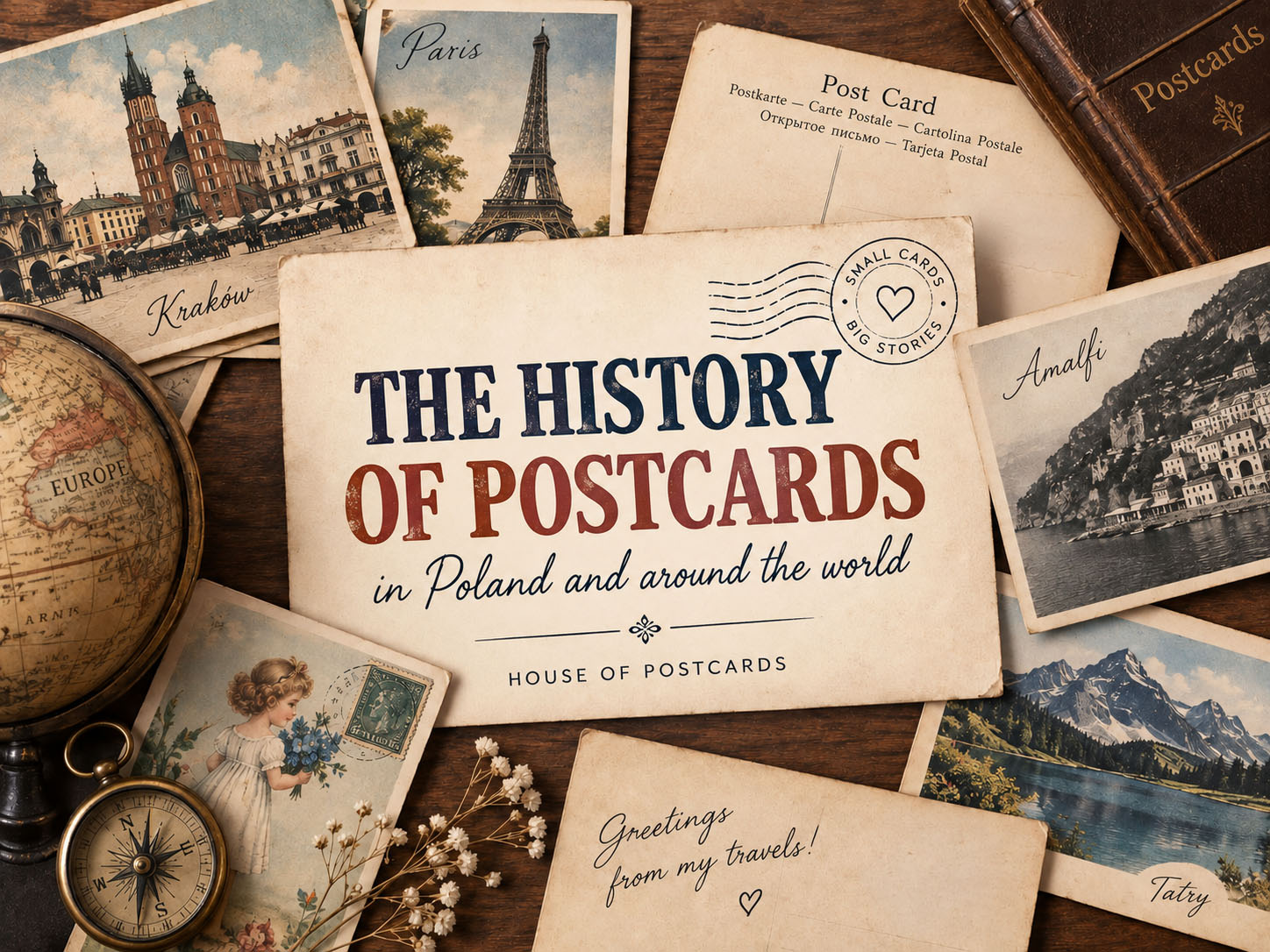
The History of the Postcard – 150 Years of Tradition That Connected the Whole World
Imagine a world without postcards...You go on holiday to Kraków, Paris or the Baltic Sea.
There are no postcard racks, you cannot send the traditional “Greetings from ...... !”.
Sounds a little like a nightmare..fortunately, it is only a bad dream 😉
And yet, for most of human history, postcards really did not exist. What is more, when the idea of sending messages on an open card first appeared, it was by no means obvious that people would fall in love with it.
Fortunately, they did 💙 and they loved it so much that at the beginning of the 20th century, the world was swept up in a genuine postcard craze.
Today, in our House of Postcards blog series, we are travelling back more than 150 years.
Before there was the postcard, there was the letter. For centuries, things were simple, if you wanted to write something to someone - you wrote a letter.
The paper was placed in an envelope or folded appropriately, the item was addressed, paid for and sent.
In the 19th century, however, the development of railways, postal services and mass tourism meant that correspondence began travelling much faster. A simpler and cheaper way of sending short messages was also needed, after all, not every message required several pages of paper.
Sometimes it was enough to say: “We arrived. Everything is fine.”. It was basically an SMS, only adapted to the technology of the time.
And this is where the real history of the postcard begins.
1869 – the year that changed the postal service
One of the most important moments in the history of the postcard is considered to be October 1, 1869. That was when the Austro-Hungarian postal service introduced the Correspondenz-Karte, or correspondence card. The idea was associated with Austrian economist Emanuel Herrmann, who proposed a simple way of sending short messages without an envelope. The idea had one major advantage, it was cheap. The card cost 2 kreuzers, while sending an ordinary letter cost 5 kreuzers. According to sources, around 1.4 million cards were sold in the very first month.
So, to put it in modern terms, the postcard went viral in the 19th century. Only instead of a million views, there were millions of pieces of cardboard travelling between post offices.
One important thing - the first official correspondence cards did not yet resemble the picture postcards we know today, and their greatest innovation was not a photograph of a beautiful city. The whole point was simply to send a short message without an envelope and more cheaply than a letter.
Only later did people begin adding illustrations, photographs, views of cities, landmarks and humorous scenes and that is when things became really interesting.
That was the moment when the card stopped being just a message - it also became a souvenir.
“Greetings from…” – the beginning of the tourist postcard
The second half of the 19th century was a period of rapid development of railways and tourism. People began travelling more often and further away.
And since they were travelling, they wanted to tell their families: “Look where I am!”
Today, we take a photo with our phone. More than a hundred years ago, people increasingly bought cards showing the places they were visiting.
The postcard became the 19th-century equivalent of today’s holiday photo sent to friends.
Except it had one advantage, you could put it on a shelf or keep it in an album.
Many years later, someone might find it at a flea market and see a city that no longer exists.
Postcards once had a very unusual reverse side. Anyone who picks up a postcard today instinctively knows:
left side – message, right side – address and stamp but it was not always like that.
At the turn of the 19th and 20th centuries, in many postal systems the entire reverse side was reserved for the address, while the message had to be written on the illustrated side.
Sometimes publishers deliberately left a small blank area next to the image where a few words could be written.
Only in later years did the divided back become widespread – the solution that seems so obvious to us today. In the United States, private postcards with a message on the left side of the reverse were officially permitted in 1907; similar solutions had appeared earlier in other countries.
So if you ever find a very old postcard and see a message written around the illustration…the sender did not mix up the sides.
1907–1915 – the Golden Age of Postcards
And now we come to a period that every collector of old postcards should know.
Its exact dates may vary slightly from country to country, but in the history of American postcards, the Smithsonian particularly identifies the years 1907–1915.
Postcards were an absolute phenomenon at the time.
People bought them while travelling, sent them for holidays, exchanged greetings, shared everyday news, flirted and joked.
Germany was a postcard powerhouse
This is one of the most interesting facts in postcard history. At the beginning of the 20th century, a huge proportion of high-quality cards available even outside Europe were printed in Germany. German printing houses were famous for their advanced lithographic techniques and the quality of their reproductions. The Smithsonian states that during the Golden Age, most postcards available in the USA were printed in Europe, primarily in Germany. World War I changed the situation dramatically. Trade was interrupted, and production in the United States had to replace European supplies to a much greater extent.
Once again, the history of the postcard proved inseparable from the history of the world.
And what was happening in Poland?
We should remember that when the Austro-Hungarian correspondence card appeared in 1869, Poland did not exist on the map of Europe. Polish lands were divided between three partitioning powers, so the development of the postcard took place within different postal systems. In territories belonging to Austria-Hungary, Austro-Hungarian correspondence cards could be found. One surviving example is a card sent on April 10, 1870 from Oświęcim to Kraków.
A truly fascinating Polish postcard story happened thirty years later, and it is connected to one of Poland’s most famous writers.
How Henryk Sienkiewicz invented… “pocztówka”. The word we use today almost without thinking has its own history. At the turn of the 19th and 20th centuries, there was no single universally accepted Polish name for this type of correspondence. Various terms were used, including words borrowed from other languages.
In 1900, on the occasion of the First Postcard Exhibition in Warsaw, a competition was organised to choose a Polish name.
Among the suggestions were such terms as:
“otwartolist”, “wiadomostka”, “oglądka”, “pisanka”, and even “listowstręt”.
Imagine Postcrossing in an alternative reality:
“Today I received three listowstręty from Japan.”
Fortunately, another suggestion won - POCZTÓWKA.
Best of all, the entry had been submitted anonymously. Only after the results were announced did it turn out that its author was Henryk Sienkiewicz.
According to the Polish Post, more than 16,000 people took part in the vote, and the winning name was announced on November 27, 1900.
Postcards are a photographic time machine. For us, this is one of the most beautiful aspects of collecting old picture postcards.
A postcard bought a hundred years ago as an ordinary tourist souvenir can today be a historical document.
We can see buildings that no longer exist, streets before reconstruction, old shop signs, trams, cars, fashion, parks before the trees grew tall.
Picture postcards are now a valuable source of information about buildings and places that were later rebuilt or disappeared completely.
History also left its mark on postcards, and the Titanic is a perfect example.
The ship entered service right in the middle of the great postcard boom. Publishers quickly produced cards depicting the famous ocean liner. But there was one problem. There were very few photographs of the Titanic, so some postcards supposedly showing the Titanic actually depicted its almost identical sister ship – Olympic. The Smithsonian National Postal Museum even describes a pre-disaster card on which the publisher used an image of Olympic and simply changed the caption to “Titanic”. So postcard “Photoshopping” of reality existed…long before Photoshop.
Photography changed everything
At the beginning of the 20th century, Real Photo Postcards – RPPCs – began gaining enormous popularity.
They were produced on photographic paper, allowing local photographers to create small series of postcards showing practically anything:
- a family-owned shop,
- a small town,
- a school,
- a railway station,
- a family standing in front of their house,
- a local event.
The popularity of such cards was linked, among other things, to Kodak cameras and technology that made it possible to produce photographs in postcard format. Today, these local RPPCs can be particularly fascinating for collectors. Sometimes only a few copies of a particular view exist.
Then came “linen” postcards
If you collect old American postcards, you have probably already seen them. They have intense colours and a distinctive surface resembling the texture of linen. These so-called linen postcards are especially characteristic of the period roughly between 1930 and 1945. Cities on these cards often looked almost too perfect, the sky bluer, the grass greener, part photograph, part illustration.
Today, they have a unique retro atmosphere. Then postcards began to look familiar
From the late 1930s onward, photochrome technology developed, making it possible to mass-produce attractive, glossy, colourful picture postcards. The year 1939 is often identified as the beginning of this era.
This is where we begin to approach the kind of postcard we know from modern tourist racks:
- colourful photographs,
- landmarks,
- panoramas,
- the sea,
- mountains,
- “Greetings from…”
- sunsets.
Then the Internet arrived…
It seemed reasonable to assume that this would be the end.
- SMS
- Messenger
Why wait several days for a card when you can send a holiday photo in a second? And yet the postcard did not disappear, it simply changed its function.
Once, it was primarily a fast and inexpensive way of sharing information, today the information itself is less important.
Because when someone sends a postcard, they have to:
- choose it,
- buy it,
- think about the recipient,
- write a message,
- find a stamp,
- address it,
- put it in a mailbox.
You cannot send a postcard completely by accident, and perhaps that is exactly why it still matters.
Postcrossing – the postcard gets a second life
In 2005, Paulo Magalhães launched the Postcrossing project.
The idea was simple: send a postcard to a stranger and receive a postcard from someone else.
The Internet, which theoretically should have killed traditional correspondence, was used to do exactly the opposite.
And so, more than 150 years after the introduction of the first official correspondence cards, people are still opening their mailboxes and feeling delighted by a piece of paper sent from the other side of the world.
7 postcard facts you can use to surprise a Postcrosser
The symbolic beginning of the modern official postcard is generally considered to be October 1, 1869 and the Austro-Hungarian Correspondenz-Karte.
The first card cost 2 kreuzers, while an ordinary letter cost 5.
Around 1.4 million such cards were sold in the first month.
For a time, old postcards had the entire reverse side reserved for the address, which is why messages were written around the illustration.
The beginning of the 20th century was a period of such enormous postcard popularity that the years 1907–1915 are described in the history of the American postcard as its Golden Age.
Germany was one of the world leaders in high-quality postcard printing before World War I.
And the Polish word “pocztówka” was given to us by Henryk Sienkiewicz, whose anonymous suggestion won a competition in Warsaw in 1900.
- It survived two world wars
- The telephone
- Radio
- Television
- Text messages
- Social media
- Smartphones
- And it is still travelling
Perhaps today we no longer need it to communicate information, and perhaps that is exactly why it has become even more special. A message on a screen appears instantly and moments later disappears among dozens of others.
Through a few sentences written on a piece of paper - “Warm greetings from Kraków. The weather is beautiful. We are coming back on Sunday.” Suddenly, someone who has been gone for a very long time speaks again, through a few sentences written on a piece of paper. Perhaps that is why, despite more than 150 years of history, the postcard is still travelling around the world.
And now a question for you:
What is the oldest postcard in your collection?
Perhaps you have a card dating all the way back to the Golden Age of Postcards?
Be sure to let us know. We would love to see the oldest postcards from your collections.