



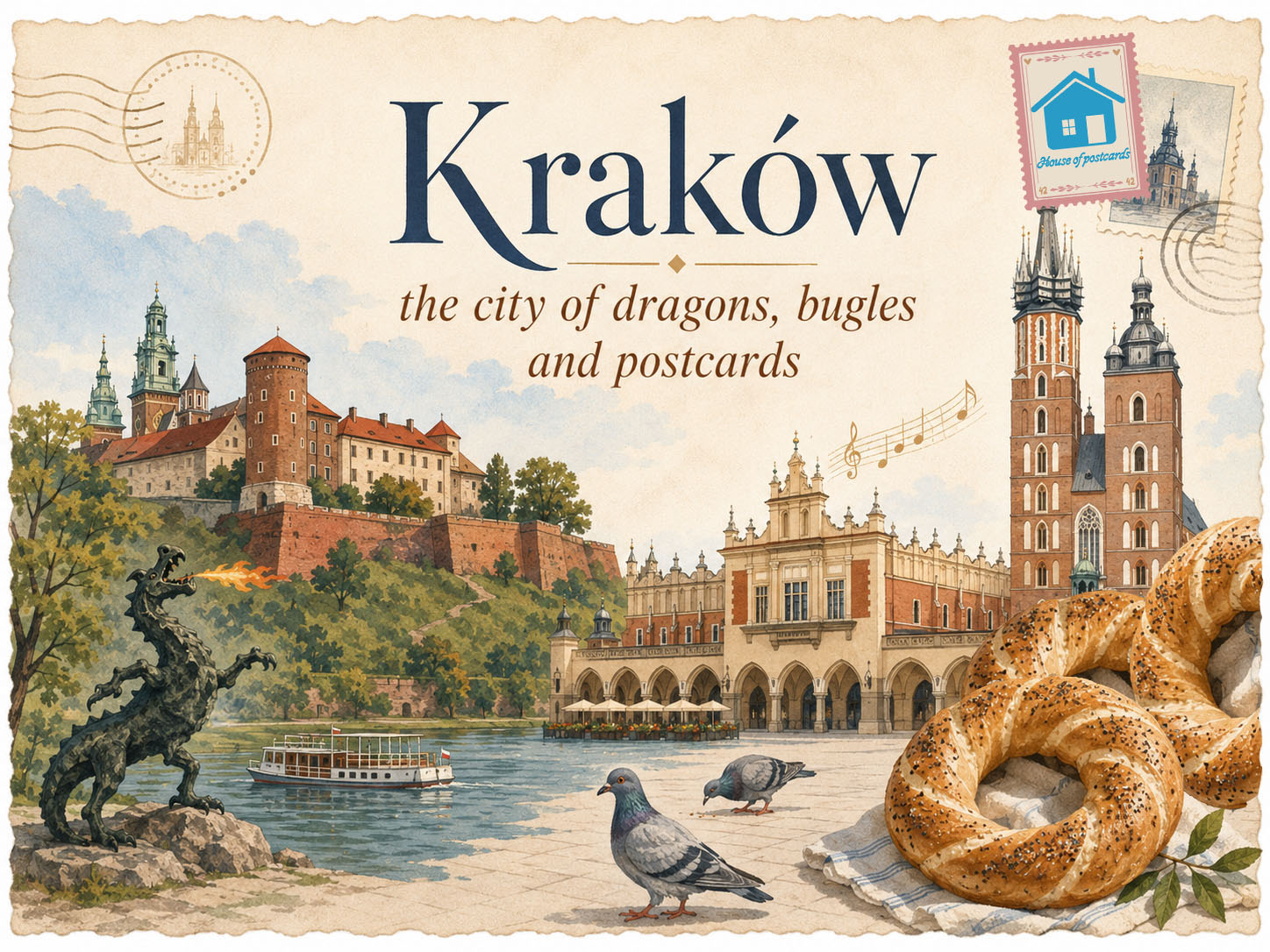
Kraków – a city where a dragon lives beneath the castle, and the bugle call never reaches its end
There are cities that can be explored in one day. Kraków theoretically can too.
But why would you do that to yourself?
Because once you have walked across the Main Market Square, visited Wawel, got lost somewhere among the streets of Kazimierz, eaten an obwarzanek and heard the St. Mary’s bugle call, you will quickly discover that the list of places you want to see “just one more of” starts growing dangerously fast.
That is why, in the next post in our House of Postcards travel-and-postcard series, we are heading to a city that seems to fit postcards exceptionally well.
Destination: Kraków!
A city of kings, artists, students, pigeons, obwarzanki and one dragon that – despite its rather unsettling history – everyone loves.
And on top of that, a place with more than a thousand years of history.
Before there were the Cloth Hall, flower sellers and crowds in the Main Market Square...
The history of Kraków began much earlier. Traces of settlement on Wawel Hill date back to prehistoric times, while the first documented mention of Kraków comes from 965. At that time, the traveller and merchant Ibrahim ibn Yaqub described it as a wealthy stronghold located on important trade routes.
One of the most important dates in the city’s history is 5 June 1257. That was when Kraków was granted a charter under Magdeburg law. The street layout with the central Main Market Square was established, and to a large extent it is still recognisable today. More than 750 years later, the Market Square is still the place where everything happens, only instead of medieval merchants we now have tourists with cameras and residents rushing to work.
Kraków – the city of Polish kings
Kraków was the former capital of Poland, a place of coronations and the burial place of Polish monarchs, gaining particular importance after 1138 as the seat of the senior duke. In 1320, Władysław Łokietek and Jadwiga were crowned in Wawel Cathedral. It was the first in a long series of royal coronations held at Wawel – another 35 took place there over the following five centuries. No wonder that walking around Wawel does not feel like visiting an ordinary castle. Here, you really are walking through a piece of Polish history.
And if history starts to feel a little too serious...you can always go down to the Vistula River to see the dragon 😉
What is worth seeing?
Wawel
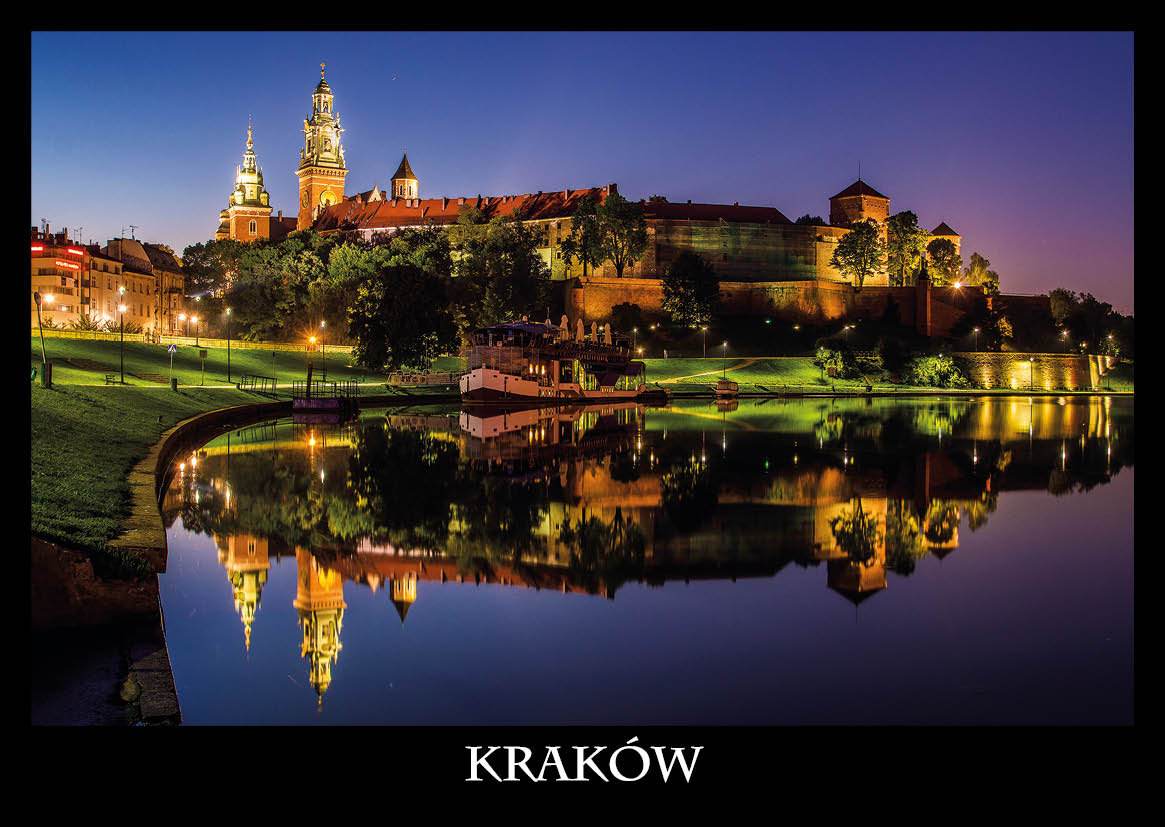
The Wawel Royal Castle is one of the most important historic complexes in Poland. For centuries, the hill was the centre of power, a place connected with monarchs, culture and some of the most important events in the country’s history - it is definitely worth spending more time at Wawel.
And once you come down from the hill...Kraków’s most famous resident is waiting for you.
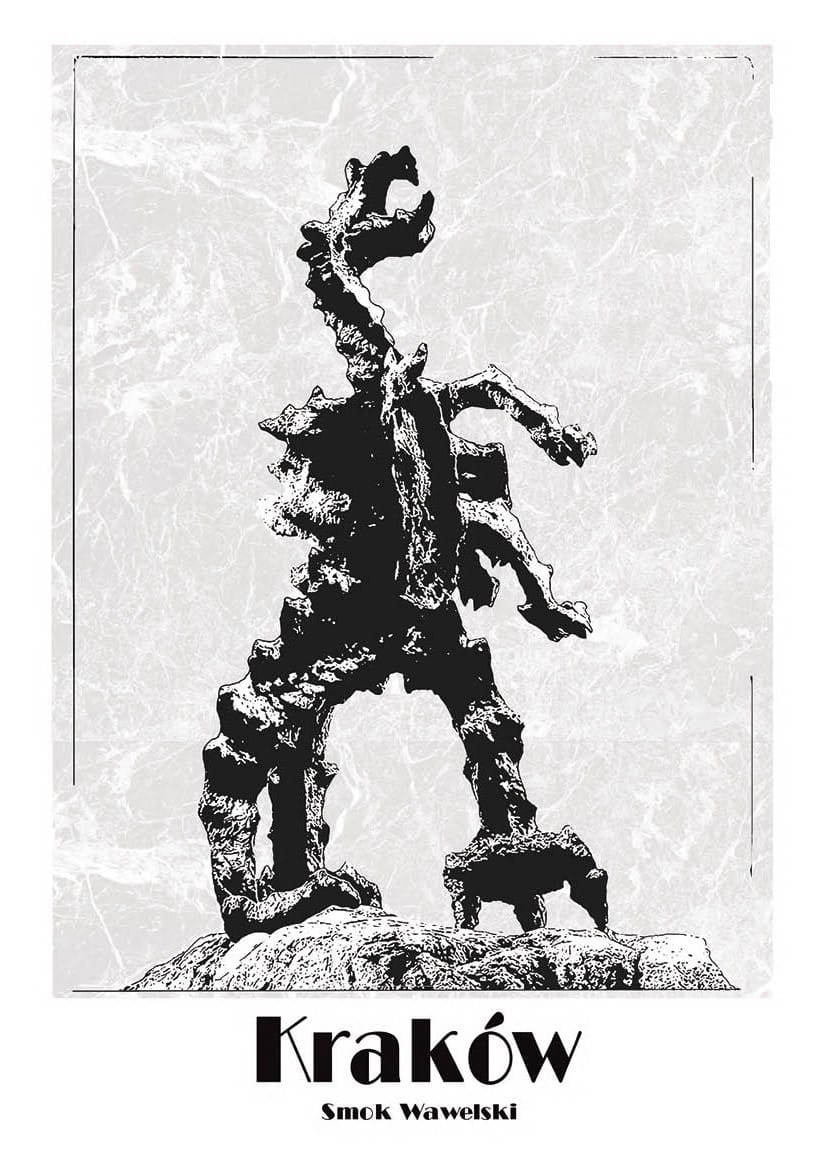
The Wawel Dragon
The legend of the Wawel Dragon has many versions and has been transformed over the centuries. The best-known modern version tells the story of a beast living beneath Wawel that terrorised the surrounding area. The dragon was defeated by trickery – it was given a sheep stuffed with sulphur. After eating it, the dragon was said to become terribly thirsty, drink water from the Vistula and... well. It did not end particularly well for him.
Historical sources show, however, that the story of the Wawel monster is much older than the popular version featuring the clever shoemaker that we know today.
Beneath Wawel is the Dragon’s Den, and in front of it stands the famous Wawel Dragon sculpture.
It is probably one of the few cases where meeting a dragon is an obligatory part of a family walk.
Main Market Square
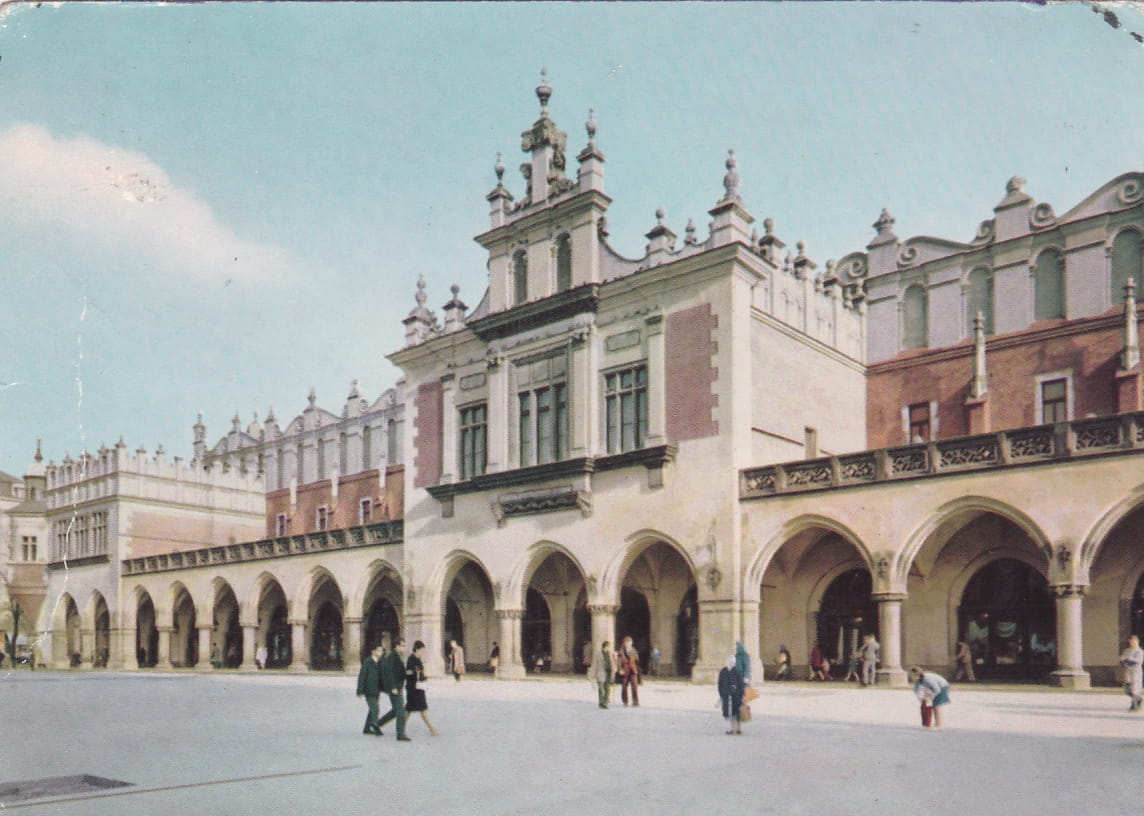
It was laid out when the city received its charter in 1257. From the very beginning, it was the centre of Kraków’s commercial, social and political life, and in many ways not much has changed. Of course, medieval trade no longer takes place here, but the Market Square is still alive practically all day long. Here you will find, among other things, the Cloth Hall, the Town Hall Tower, St. Mary’s Basilica and the Adam Mickiewicz Monument, and of course pigeons. Lots of pigeons.
At its centre stands MNK Sukiennice – once a trading space, today also home to an art gallery.
If, while walking around the Market Square, you hear a trumpet from St. Mary’s Tower, that is the bugle call, which is played every hour in turn towards the four points of the compass. However, the melody suddenly stops.
And this is where history meets legend. According to a popular story, during the Tatar invasion of 1241, a watchman spotted the danger and began playing an alarm. Before he could finish the melody, an arrow pierced his throat. That is why the bugle call still stops at the same point today.
It is definitely worth stopping in the Market Square to hear it at least once.
Kazimierz
A walk of just over ten minutes is enough for the atmosphere of the city to change completely.
For centuries, Kazimierz developed as a separate town, and its history is strongly connected with Jewish culture. Today, alongside synagogues, churches and historic tenement houses, you will find cafés, galleries, restaurants and small shops. This part of Kraków shows just how many different stories can fit into a single city. Historic Kazimierz is also part of Kraków’s historic centre inscribed on the UNESCO World Heritage List.
Collegium Maius of the Jagiellonian University
It is difficult to imagine Kraków without students.
In 1364, Casimir the Great founded the Kraków Academy, which gave rise to today’s Jagiellonian University.
One of the places connected with the university’s history is the Jagiellonian University Museum Collegium Maius. Its courtyard is one of those places where even people who are not interested in university history suddenly take out their phones and snap a photo. Simply because it is beautiful.
Planty
Kraków’s Old Town was once surrounded by defensive walls with towers and gates. Today, much of the former fortification belt is occupied by Planty – a green park surrounding the historic centre. Reminders of the old fortifications include the Barbican and St. Florian’s Gate. If the Main Market Square has tired you out, head to Planty.
Kraków nativity scenes – something you could never confuse with another city
Kraków nativity scenes resemble fantastical, multicoloured palaces inspired by the city’s architecture. You can spot the towers of St. Mary’s Basilica, domes, turrets and other elements inspired by Kraków’s landmarks. The tradition originated in the 19th century and has been passed down from generation to generation. In 2018, the tradition of Kraków nativity scenes was inscribed on UNESCO’s Representative List of the Intangible Cultural Heritage of Humanity.
Kraków and UNESCO
The historic centre of Kraków was inscribed on the UNESCO World Heritage List as early as 1978, during one of the first sessions when the list was being created.
In the same year, Poland’s Wieliczka Salt Mine was also inscribed. Kraków therefore became part of the very first group of just 12 sites placed on the World Heritage List at that time. The listed area includes not only the Old Town, but also Wawel and historic Kazimierz.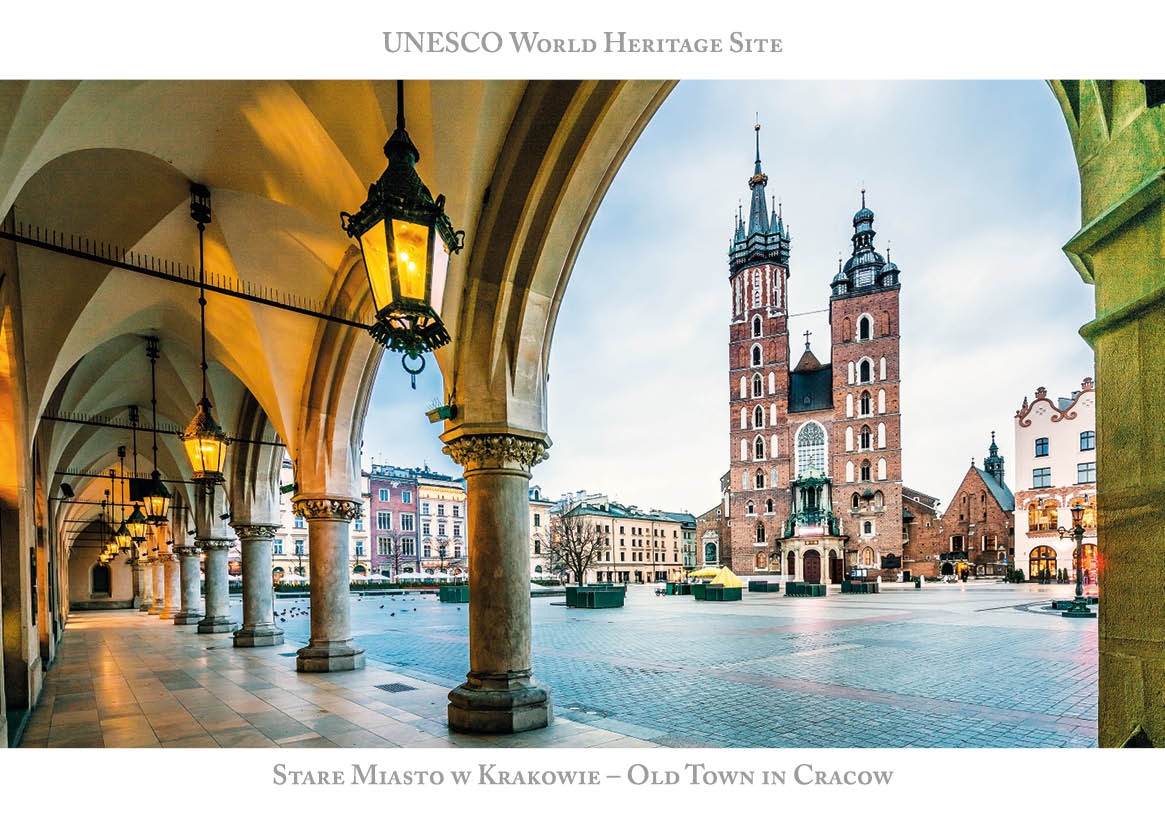
A summary of Kraków facts:
- The first written mention of Kraków dates back to 965 and comes from Ibrahim ibn Yaqub.
- Coronations of Polish monarchs took place in Wawel Cathedral. The first in 1320 was the coronation of Władysław Łokietek and his wife Jadwiga.
- The origins of the Jagiellonian University date back to 1364, when Casimir the Great founded the Kraków Academy.
- The St. Mary’s bugle call is played every hour, around the clock and towards the four points of the compass. The story about the Tatar arrow, however, is a legend.
- The tradition of Kraków nativity scenes is included on UNESCO’s list of intangible cultural heritage.
- Kraków was included on the first UNESCO World Heritage List in 1978.
Now for something particularly interesting to us – Kraków on postcards
Postcards allow us to observe how the city has changed over the decades. Old ones show a Kraków that no longer exists – the clothes worn by passers-by, old cars, horse-drawn carriages, shop signs and the appearance of the streets.
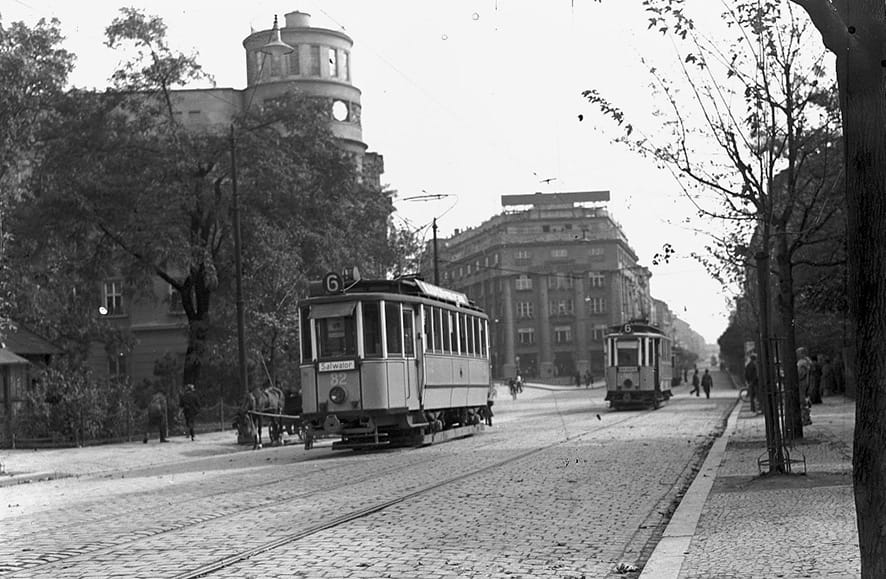
Modern postcards, on the other hand, can show exactly the same places more than a hundred years later.
And these are exactly the kinds of comparisons we love.
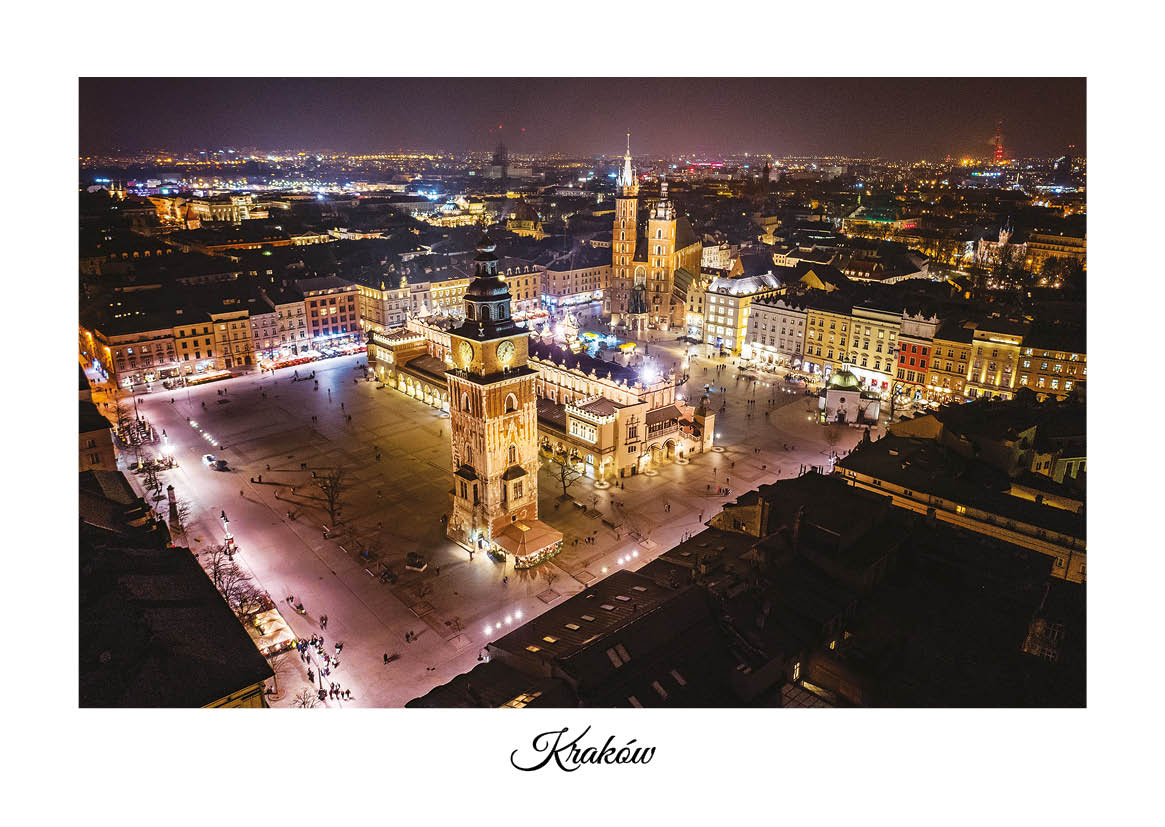
Kraków on House of Postcards postcards
If you are going to Kraków and planning to send a few cards...there is definitely plenty to choose from.
At House of Postcards you will find postcards showing Kraków in many different ways – classic view cards, photographs, illustrations and more unusual designs.
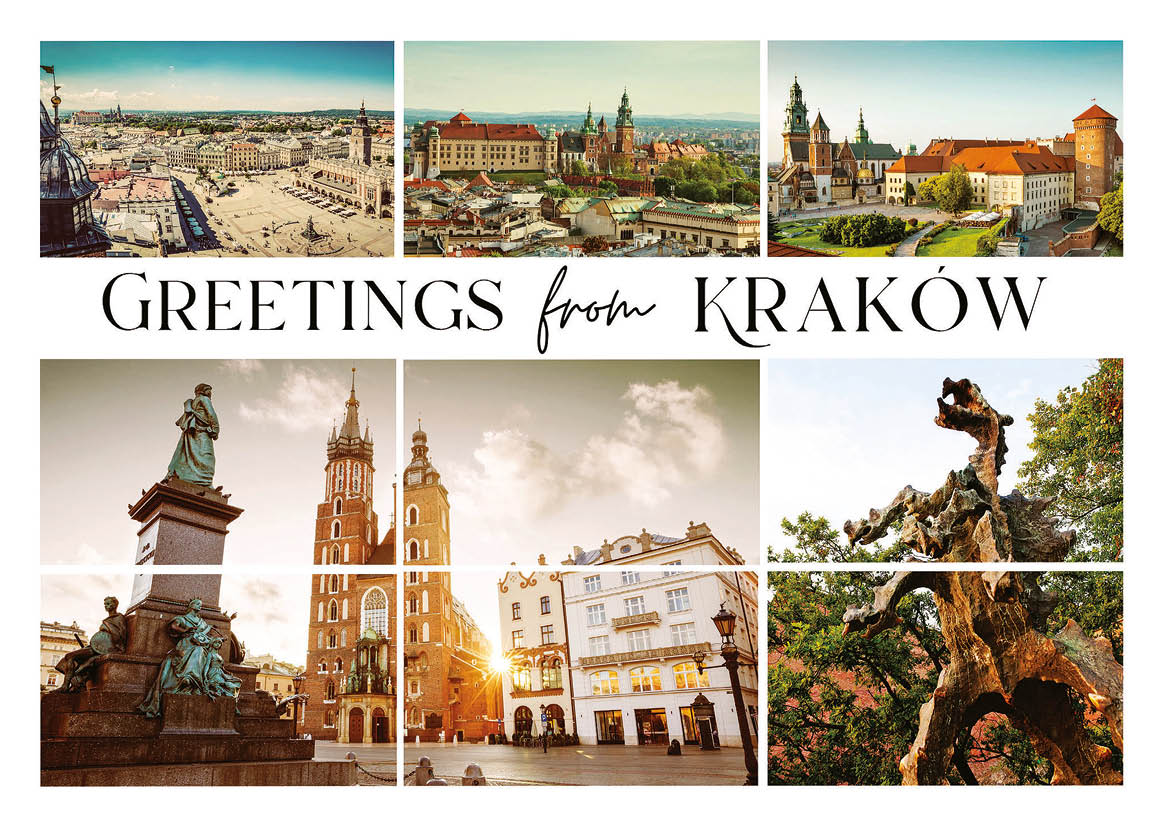
And we have a little challenge for you.
Next time you are in Kraków, instead of simply sending someone a photo on Messenger...buy a postcard. Sit somewhere near the Main Market Square, write a few words, stick on a stamp and send it to someone who will not be expecting it at all.
A photo on your phone will probably disappear among thousands of others, while a postcard may stay with someone for many years.
Is Kraków worth visiting?
See if you can really leave the Main Market Square without buying an obwarzanek, and then choose the postcard that best tells someone the story of your Kraków. Because this is a city with the magical quality that everyone remembers it a little differently, and perhaps that is exactly why one postcard from Kraków is never enough.
And of course, our travel-and-postcard series continues.
Which town or city should we visit next time?
Source: House of Postcards Archive