



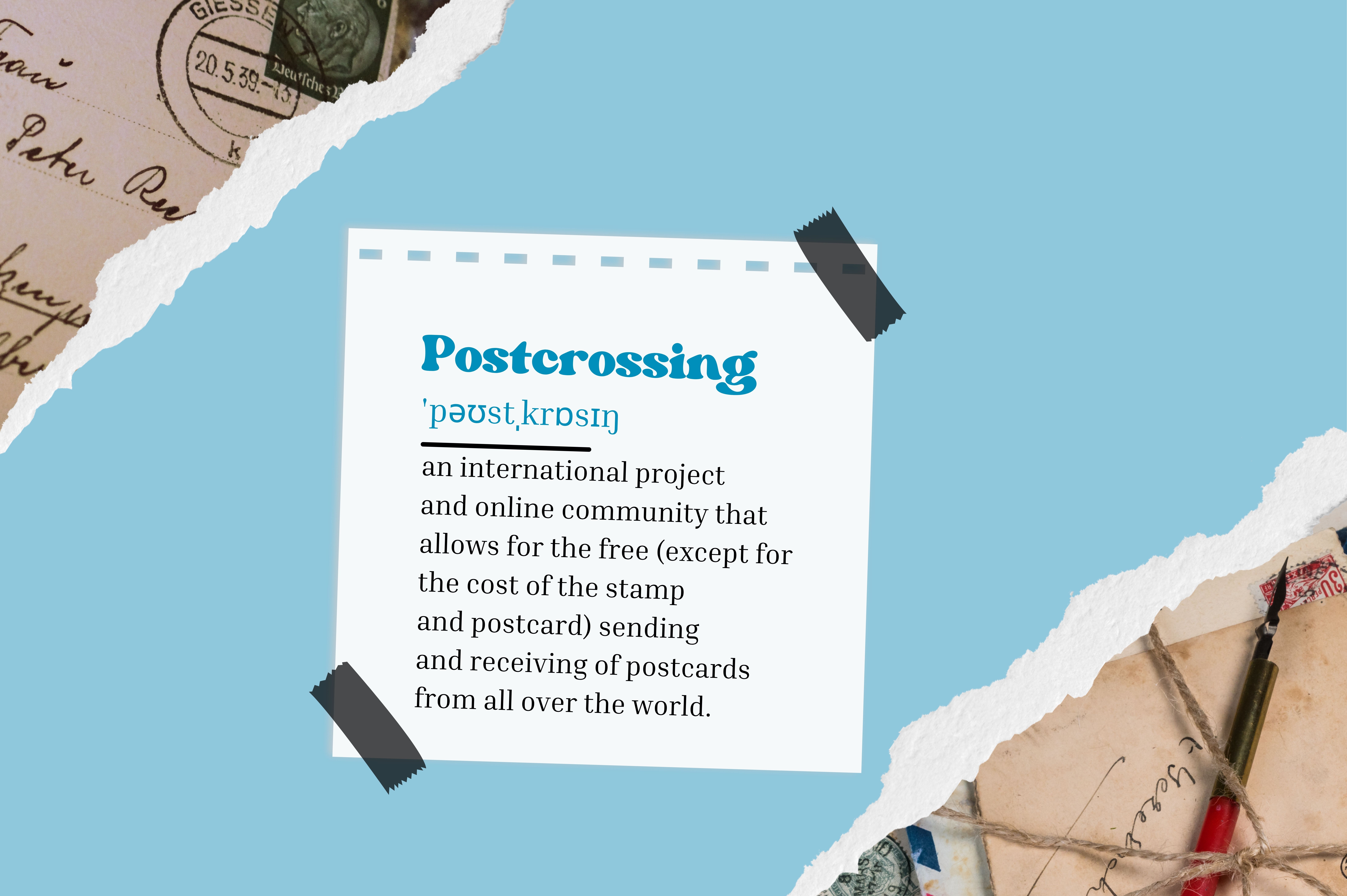
Postcrossing
It is an international project that allows you to exchange postcards with complete strangers from all over the world. For every postcard you send, you receive one from another participant in the project.
You do not choose the country.
You do not choose the person.
You do not know where your next postcard will come from.
And it is precisely this uncertainty that makes it so difficult to stop.
The project was launched on 14 July 2005 by Paulo Magalhães from Portugal, who loved receiving traditional mail and wanted to create a place where people with the same passion could find one another. From the very beginning, the aim was to connect people from all over the world through real postcards – regardless of their age, nationality or beliefs.
Today, Postcrossing operates in more than 200 countries and territories, has over 800,000 users, and the number of exchanged postcards has already exceeded 85 million. Every day, more postcards travel thousands of kilometres, bringing smiles to their recipients.
How to start your Postcrossing adventure
Starting your Postcrossing adventure is really simple. You do not need any experience, special skills or an enormous postcard collection. All you need is a few minutes of free time, internet access and a desire to discover the world.
The first step is to register on the official Postcrossing website. The entire process is free and takes only a few minutes.
When creating your account, you will be asked to provide:
a username (nickname),
an email address,
a password.
Once your account has been activated, you can log in to your profile.
At this stage, you do not need to send or buy anything yet. However, it is worth taking a moment to complete your profile.
Your profile
This is one of the most important parts of Postcrossing. Before someone chooses a postcard for you, they will probably read your description.
It is a little like introducing yourself to someone you have never met before.
The more interesting your profile is, the greater the chance that you will receive postcards perfectly suited to your interests.
There is no single "perfect" profile; the most important thing is that it is honest.
You can write a few sentences about yourself.
For example:
which country you come from,
what you are interested in,
why you joined Postcrossing,
what your hobbies are,
what makes you happy.
You do not need to tell your entire life story. Write about the kinds of postcards you like. Most postcrossers genuinely try to choose a postcard that will make the recipient happy.
If you write only: "I like postcards.", the sender will not really know what you are looking for.
It is much better to write something more specific.
For example:
watercolour illustrations,
maps,
lighthouses,
castles,
mountains,
national parks,
cats,
dogs,
birds,
trains,
trams,
UNESCO World Heritage sites,
architecture,
art,
folklore,
hand-painted illustrations,
postcards showing the everyday lives of people in a particular country.
The more suggestions you provide, the easier it will be for someone to choose the right postcard.
It is also worth mentioning what you do not like.
Perhaps you are not fond of advertising postcards or do not collect cards featuring photographs of flowers.
This information is very helpful.
However, remember that Postcrossing is based on kindness.
Your profile should encourage someone to send you a postcard rather than look like a list of demands.
It is a suggestion, not a requirement.
Remember that the person sending the postcard can only choose from what is available to them. They may not always be able to find exactly the design you dreamed of.
And that is completely normal.
Ideally, your profile should be written in English. This is the language used by the vast majority of the Postcrossing community.
However, you do not need to write perfectly; nobody expects literary English.
Postcrossing works entirely through traditional mail.
To receive postcards from all over the world, you need to provide an address where they can be delivered. Your address is not public.
It can only be seen by the person who draws you as the recipient of a postcard at that particular moment. It does not appear on your public profile and is not made available to other users unnecessarily.
It is best to enter the address exactly as it is used by the postal operator in your country.
In Poland, it usually looks like this:
Jan Kowalski
Kwiatowa 15/7
00-001 Warszawa
POLAND
The final line containing the name of the country should be written in capital letters. This makes it much easier for foreign postal services to direct the item to the correct country.
If you live in an apartment building, remember to include your apartment number.
If your house has a name or an additional marking needed by the postal worker – it is also worth adding it.
Your profile is ready.
Congratulations!
You now have an account and a completed profile.
Only the most exciting moment remains… Drawing your first address and sending your first postcard.
On the Postcrossing website, you will find a button marked "Send a postcard".
After clicking it, the system will randomly select an address belonging to one person somewhere in the world.
Once the address has been drawn, the system will display several very important pieces of information.
Most importantly, you will see:
the recipient’s name or username,
their full postal address,
the recipient’s country,
the Postcard ID,
the recipient’s profile.
At the beginning, the number of active postcards is limited.
A new user may have a maximum of 5 active official postcards travelling at the same time.
Every official postcard sent through Postcrossing is assigned its own unique identification number - the Postcard ID
The Postcard ID must be written clearly on the postcard.
The most important thing is that it can be read easily. Without it, the recipient will not be able to register the postcard they have received.
Choosing a postcard
This is probably the most enjoyable part of the entire process. There is no single "perfect" postcard.
The best one will be the one that makes the recipient happy.
If they wrote in their profile that they love lighthouses and you have such a card — perfect.
If they collect maps — choose a map.
If they like watercolour illustrations — look for that kind of design.
If you do not have anything from the list, do not worry.
The most universal choices are postcards showing:
recognisable places in your city, monuments, landscapes, local culture, traditions and nature.
It is thanks to postcards like these that Postcrossing becomes a journey around the world.
Popular postcard designs
🗺️ Map Cards
🌍 Greetings From...
🎨 watercolour illustrations
🏛️ UNESCO World Heritage sites
🏰 castles and palaces
🌊 lighthouses
🚂 railways and trams
🚲 bicycles
🚢 ships
🌲 national parks
🦊 animals
🐈 cats
🐕 dogs
🦉 birds
🌺 flowers
🍄 mushrooms
🌌 astronomy
🌠 the Northern Lights
🎄 Christmas
🎃 Halloween
🥟 regional cuisine
👘 traditional clothing
🎭 folklore
🖼️ art
📚 books
🎼 music
☕ coffee
🍰 sweets
🚗 classic cars
✈️ aviation
⚓ maritime themes
🧸 vintage
📷 photography
🖌️ illustration
🎨 art cards
🖍️ cartoon cards
📮 mailbox cards
🚪 doors & windows
🌉 bridges
🏙️ city panoramas
🏕️ nature
🌄 mountains
🏖️ beaches
❄️ winter
🌸 spring
☀️ summer
🍁 autumn
The envelope
In official exchanges, most postcrossers strongly prefer postcards sent without an envelope. This allows the postcard to truly travel and receive postal cancellations on its stamps.
These are the traces of its journey, and for many collectors, they are part of the postcard’s story.
Envelopes are most commonly used for private exchanges, when sending several postcards at once or when we want to protect a particularly valuable card.
Stamps
Whenever possible, choose commemorative stamps or stamps featuring interesting illustrations.
Postcrossers often collect not only postcards but stamps as well.
A beautiful stamp can bring the recipient almost as much joy as the postcard itself.
It is also worth checking that the value of the stamps matches the current postal rate for international mail.
What to write
A few sentences are genuinely enough.
You can write:
a few words about your city,
about the weather,
about your interests,
about why you chose that particular postcard.
The most important thing is that your message comes from the heart. It is not the length that matters, but remembering the person on the other side.
The postcard has been sent — what happens next..
Once the postcard has been sent, all that remains is to…be patient and wait.
The average travel time depends on the country, the distance and the work of the postal operators.
Some postcards arrive within a few days, while others need several weeks.
This is completely normal.
When the recipient receives the postcard, they will register it on the Postcrossing website using the Postcard ID.
You will then receive an email informing you that your postcard has safely reached its destination. The recipient will often also leave a short thank-you message, known within the community as a „Hurray!”, in which they share their impressions of the postcard.
And most importantly…
At the same moment, your address will be given to another Postcrossing user.
This means that very soon, you too will be eagerly waiting for the postal worker.
Receiving your first postcard is a moment that most postcrossers never forget.
Missing Postcard ID
In this situation, you can ask the support team for help identifying the ID. Use the „Request help to find an unknown ID” form. You will find it on the postcard registration page. Provide as many details as possible: what the postcard looks like, the date of the postmark, the place from which it was sent and any other information visible on the card. The more details you provide, the greater the chance that the Postcrossing team will find the correct number.
If you know the sender’s username, you can also send them a private message asking them to confirm the Postcard ID.
The most common mistakes made by beginner postcrossers
Every one of us once sent our first postcard. Everyone wondered whether they had used the correct stamp.
Whether the address was correct. Whether the message was too short.
This is completely natural.
The good news is that most mistakes are very easy to avoid.
That is why we have collected the most common situations experienced by beginner Postcrossing users. These are not "prohibitions", but practical tips based on the experience of the community.
Not reading the recipient’s profile
A user’s profile is not merely a decoration, but a place where the recipient suggests what brings them the most joy. Sometimes one minute is enough to discover that someone collects maps, loves owls or dreams of receiving postcards from national parks.
It is not always possible to fulfil every request, but it is worth trying.That is exactly what makes Postcrossing so special.
Treating the profile like a list of requirements
Some beginners feel stressed when they do not have a postcard from the recipient’s wish list.
There is no need.
A profile contains preferences, not demands.
If you do not have a lighthouse postcard, send a beautiful illustration of your city.
The most important thing is that the postcard is chosen with kindness.
Forgetting the Postcard ID
Without the Postcard ID, the recipient will not be able to register the postcard.
Before putting the card in the postbox, always check:
whether the number has been written down,
whether it is complete,
whether it can be read easily.
It is a small detail that makes an enormous difference.
Illegible handwriting
Not everyone has beautiful calligraphic handwriting.
And there is no need to.
However, remember that your message will often be read by someone for whom English is not their native language either.
Write clearly.
Avoid writing in very small letters.
An address that is too short or incomplete
The address should be copied exactly as it appears on Postcrossing.
Do not shorten street names.
Do not omit the postcode.
Do not change the order of the address elements.
Using stamps with the wrong value
This mistake happens particularly often after postal prices change.
Before sending your postcard, check the current international postage rate.
This will help you avoid the risk of the postcard not being sent.
Writing only one sentence
There is no obligation to write a long message.
However, a message such as: "Happy Postcrossing." without any additional sentence may feel very impersonal.
Simply add a few words about your day, the weather or your city.
It really makes a difference.
Ignoring requests concerning envelopes
Most official postcards are sent without an envelope.
Sometimes, however, the recipient clearly states that they collect postcards in perfect condition and asks for them to be sent in an envelope.
If you are able and willing to fulfil this request – wonderful.
If not, that is also perfectly fine.
Kindness is what matters most.
Waiting too long before sending the postcard
The address has been drawn and the postcard is lying on your desk.
Two weeks pass.
Then three.
Different situations happen in life, but it is worth remembering that someone on the other side is waiting for their postcard.
Whenever possible, try to send it within a few days of drawing the address.
Writing only about yourself
It is natural that you want to introduce yourself.
However, the recipient will usually be more interested in reading a few sentences about your country, city or everyday life than a very detailed life story.
The most interesting messages find the right balance.
A little about you.
A little about the place.
A little about the postcard.
The moment you find a postcard from the other side of the world in your mailbox can bring a smile to your face and brighten your day.
Do not be afraid of making mistakes.
At the end, we would like to tell you something very important.
There is no such thing as a perfect postcrosser.
Everyone has forgotten to add the date at least once.
Everyone has wondered whether their message was too short.
Everyone has felt nervous before sending their first postcard.
And that is exactly why the Postcrossing community is so friendly.
We are connected not by perfection, but by the joy of sending and receiving postcards.
Everything else comes with time. :)